SK Enterprises Manufacturer of Industrial Magnetizers & Magnetic Instruments — Maharashtra, India

Magnetizer Machines

Capacitive Discharge Impulse Magnetizers (Magnet Charging Machines)

A capacitive discharge impulse magnetizer — also called a magnet charging machine — stores energy in a capacitor bank and releases it through a magnetizer coil or fixture as a short, very high-current pulse. The resulting magnetic field saturates the magnet in a fraction of a second. SK Enterprises manufactures them in Pune, Maharashtra, for motor, automotive, audio and magnet manufacturers across India.

  • Magnetizes ferrite, NdFeB, SmCo and alnico magnets and assemblies
  • Adjustable charging voltage for repeatable, controlled pulses
  • Works with interchangeable coils and part-specific fixtures
  • Built-in safety interlocks and automatic capacitor discharge
Magnetizer type
Capacitive discharge impulse
Operating principle
Capacitor bank discharged through coil / fixture via thyristor (SCR) switch
Stored energy
Typically from about 1 kJ to 20 kJ or more, depending on model
  • Direct from manufacturer
  • Built to your part
  • Application support

Product overview

About Capacitive Discharge Impulse Magnetizers

What is a capacitive discharge impulse magnetizer?

A capacitive discharge impulse magnetizer — also known as a capacitor discharge (CD) magnetizer — is the most widely used type of industrial magnetizer. It charges a bank of capacitors to a set voltage and then discharges it through a magnetizer coil or fixture using a high-current switch. The current rises to thousands of amperes for a few milliseconds, and the coil turns that current into an intense magnetic field. Because the energy arrives as one short impulse, it is also called an impulse magnetizer or a pulse magnetizer.

The pulse is so short that the coil carries enormous current without overheating — which is how a machine on a normal power supply can create fields strong enough to saturate even NdFeB magnets.

Why manufacturers magnetize in-house

Many manufacturers buy magnets unmagnetized and charge them after assembly. This avoids the problems of handling strong magnets on the line — parts snapping together, chipped magnets and steel swarf sticking to every surface — and makes sure each finished product is fully magnetized. A magnet charger machine at the end of the line becomes the single point where every part receives the same, controlled pulse.

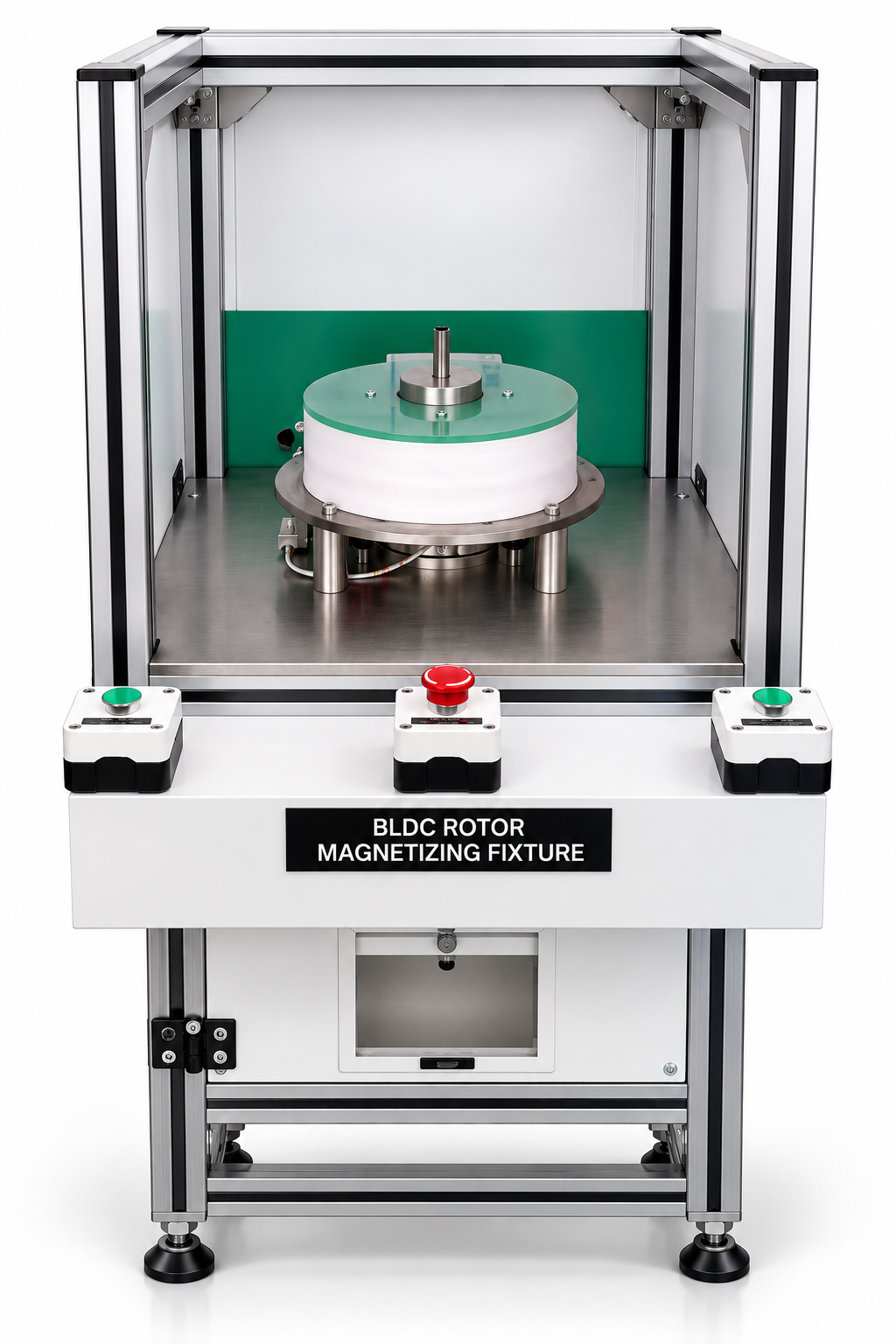
Typical examples include BLDC rotors, DC motor housings, loudspeaker magnet assemblies and magnets for sensors.

Choosing the right magnetizer

Energy and voltage

The energy rating (in kilojoules) and maximum voltage must be enough to drive the required field into your part through the chosen fixture. Larger parts, higher-coercivity magnets and multi-pole patterns all need more energy.

Fixture or coil

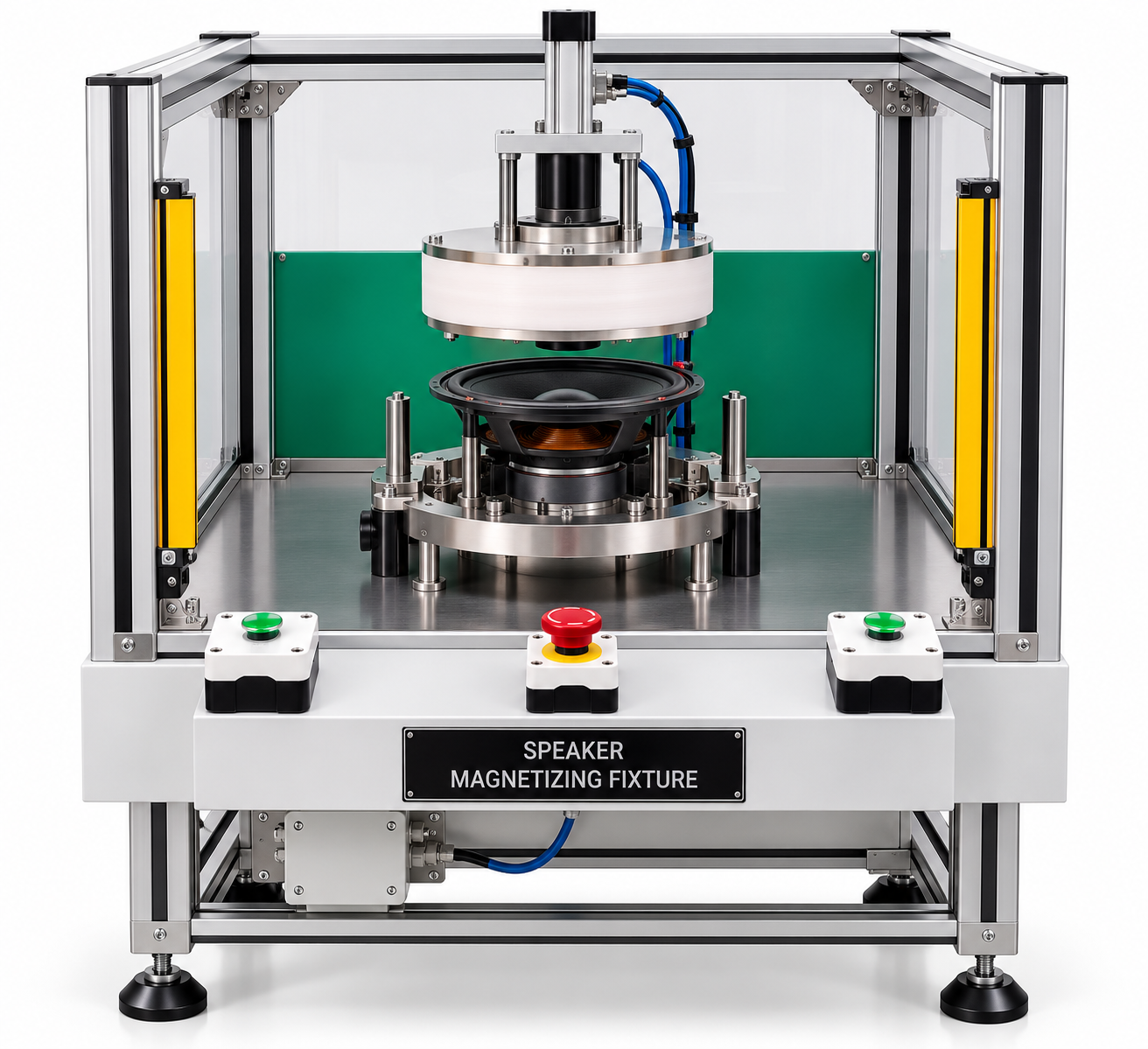
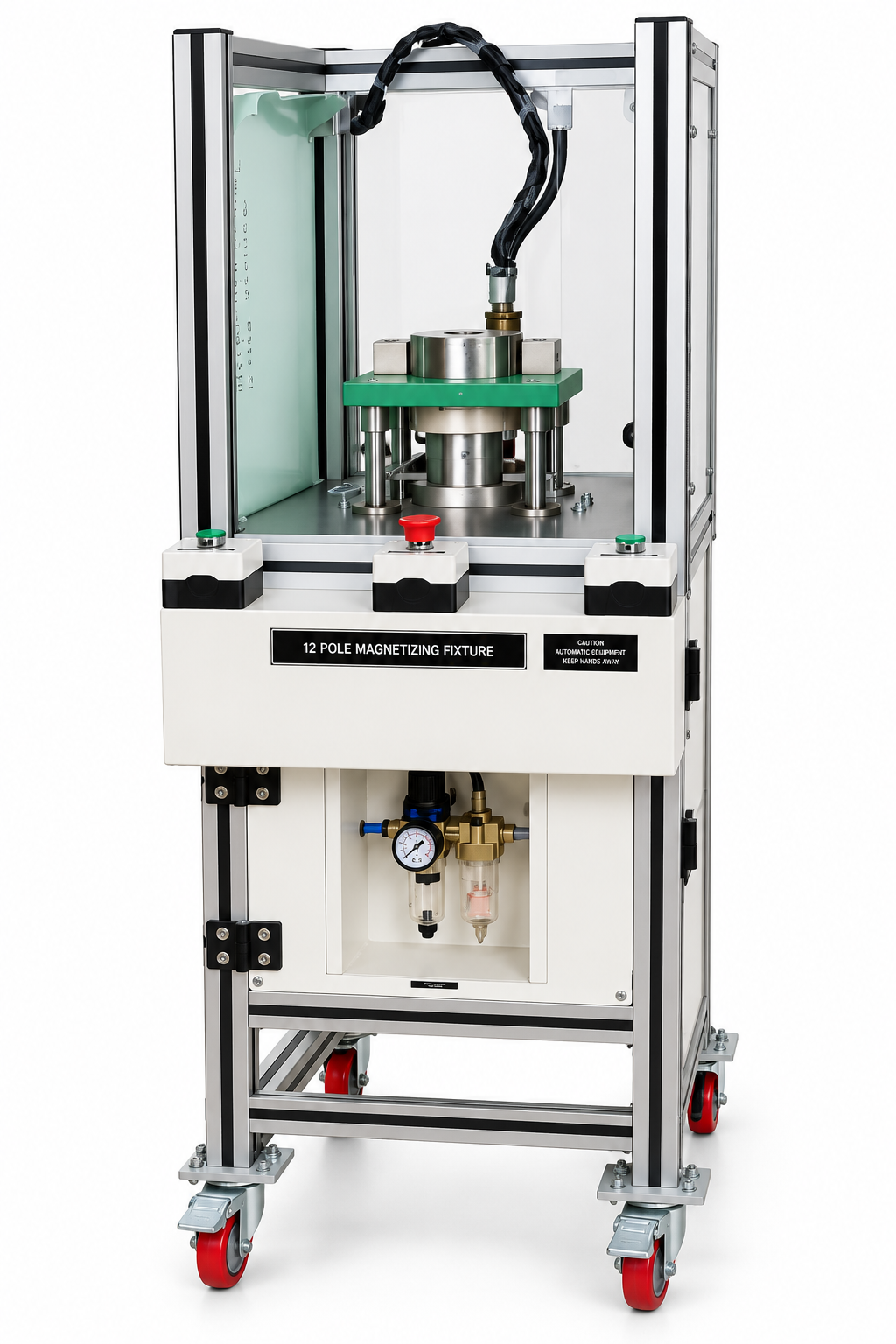
A magnetizer coil suits loose magnets magnetized through their thickness. Rotors, housings and multi-pole parts need a part-specific magnetizer fixture.

Production rate and monitoring

For production use, consider cycle time, fixture cooling and whether you need peak-current monitoring to confirm that every part received a full pulse. Our guide on how to choose a magnetizer covers these points in detail.

Capacitive discharge impulse magnetizer manufacturer in Pune

SK Enterprises designs and manufactures capacitive discharge impulse magnetizers in Pune, Maharashtra, for production lines, tool rooms and laboratories across India. Tell us what you magnetize, the magnet material and your output per shift, and we will propose a machine and fixture combination.

What decides the price of a magnet charging machine?

There is no single list price, because every machine is configured around the parts it will magnetize. Two machines that look alike from the outside can differ widely in what they contain. These are the main cost drivers:

Cost driver How it affects the price
Energy rating Larger capacitor banks and chargers — for big parts, NdFeB grades or batch charging — cost more than compact machines for small ferrite parts.
Maximum voltage Capacitors, switches, cables and insulation all have to be rated for the highest voltage the machine can reach.
Coil or fixture design A standard solenoid coil is simpler than a part-specific rotor, housing or multi-pole fixture, and each additional fixture adds to the order.
Cooling and cycle time Shorter cycles need a more powerful charger and forced-air or water-cooled fixtures.
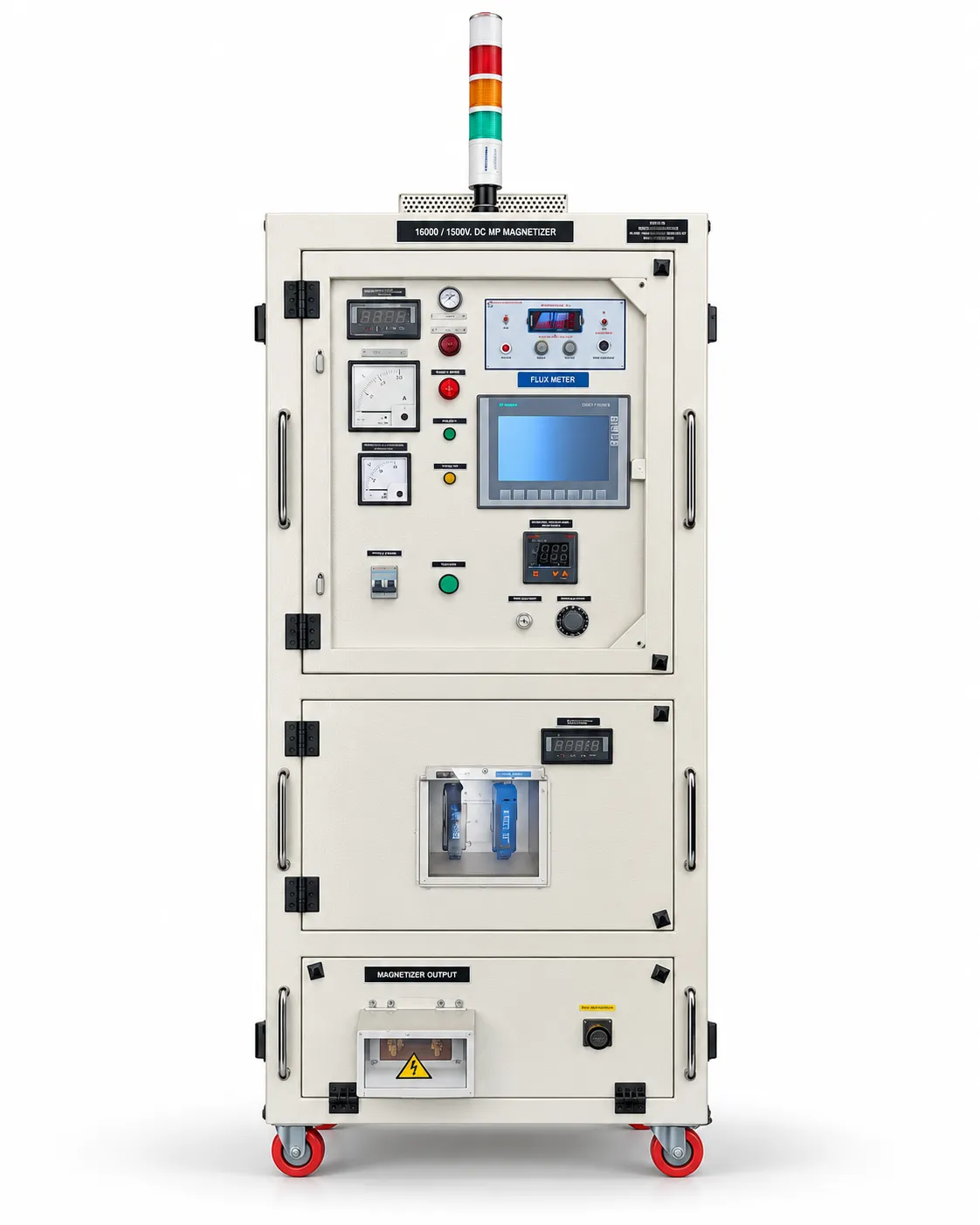
Controls and monitoring Basic push-button controls cost less than digital voltage setting, peak-current monitoring, data logging or a PLC with HMI.
Automation Automatic loading, part detection, reject handling and line interfaces add hardware and engineering time.
Installation and support On-site installation, commissioning, operator training and recommended spares are part of the total cost.

Comparing quotations on energy rating alone can mislead: a cheaper machine that cannot saturate your most demanding part, or a fixture that overheats at your production rate, soon costs more in rejects and downtime. Our article on magnet charging machine price in India explains each factor in more detail.

For an accurate figure, share your part drawing, magnet material and grade, pole pattern and output per shift. Request a quotation for a capacitive discharge impulse magnetizer.

Specifications

Capacitive Discharge Impulse Magnetizers specifications

Typical technical specifications
Operating principle Capacitor bank discharged through coil / fixture via thyristor (SCR) switch
Stored energy Typically from about 1 kJ to 20 kJ or more, depending on model
Charging voltage Typically adjustable, commonly up to 1,000 – 3,000 V
Pulse duration Typically a few milliseconds
Peak current Typically several kA up to tens of kA, depending on fixture
Magnet materials Ferrite, NdFeB, SmCo, alnico (energy and fixture dependent)
Input supply Single-phase 230 V or three-phase 415 V, 50 Hz (model dependent)
Controls Voltage setting, charge / fire controls, safety interlocks

Typical values for this product type, for reference. Exact values depend on grade, size and design — confirm with our team before ordering.

Models & supply from SK Enterprises
Models / energy ratings On request
Input supply options On request
Control options On request
Fixtures supplied On request
Installation & training On request
Warranty On request
Lead time On request

Sizes & variants

Common types and variants

Bench-top magnetizers

Compact machines for laboratories, sample work and small parts or low-volume production.

Production magnetizers

Higher-energy machines for continuous shop-floor use with fixtures and foot-switch or automatic operation.

Magnetizers with monitoring

Machines that record peak current for every pulse so incorrectly magnetized parts can be rejected.

Line-integrated magnetizers

Machines with PLC interfaces for automatic loading and magnetization on assembly lines.

Applications

Applications of Capacitive Discharge Impulse Magnetizers

  • Motor rotors and housings

    Magnetization of BLDC and PMSM rotors and DC motor housings after the magnets are assembled.

  • Loose magnet charging

    Charging ferrite and NdFeB magnets in batches through a solenoid coil before dispatch or assembly.

  • Loudspeaker assemblies

    Magnetization of a speaker's magnet circuit after it is glued and assembled.

  • Sensors and encoders

    Creating precise pole patterns in small ring and disc magnets with multi-pole fixtures.

  • Re-magnetization

    Restoring the magnetization of magnets and assemblies that have weakened in service or rework.

Features & benefits

Capacitive Discharge Impulse Magnetizers features & benefits

Key features

  • Controlled, repeatable pulse Set the charging voltage once and every pulse delivers the same energy, part after part.
  • Fixture flexibility One machine drives different coils and fixtures, so a new product does not need a new magnetizer.
  • Safety by design Interlocked operation and automatic discharge of the capacitor bank protect the operator.
  • Built for the shop floor Robust construction for daily industrial use.

Benefits for your business

  • Safer assembly Assemble unmagnetized parts and magnetize at the end, avoiding pinching, chipping and steel debris.
  • Consistent product quality Fully saturated magnets give consistent motor torque, speaker output and sensor signals.
  • Lower handling cost Unmagnetized magnets are easier to store, transport and feed into automatic assembly.
  • Direct from the manufacturer Work with the team that builds the machine for configuration, spares and support.

Industries served

Industries that use Capacitive Discharge Impulse Magnetizers

Get the right Capacitive Discharge Impulse Magnetizers for your application

Send your part drawing, magnet material and output per shift. Our engineers will recommend the right configuration and send a quotation.

FAQs

Capacitive Discharge Impulse Magnetizers — frequently asked questions

What is a capacitive discharge impulse magnetizer?

It is an industrial magnetizer that charges a bank of capacitors and then discharges it through a magnetizer coil or fixture as one short, high-current impulse. The impulse creates a magnetic field strong enough to saturate ferrite, NdFeB, SmCo and alnico magnets. It is also called a capacitor discharge magnetizer, an impulse magnetizer or a magnet charging machine.

What is a magnet charging machine?

It is the common name for a magnetizer (also spelt magnetiser) — a machine that magnetizes (charges) permanent magnets. A capacitor discharge magnetizer stores energy in capacitors and releases it through a coil or fixture as a short, powerful pulse that saturates the magnet.

How does a magnetizer machine work?

A charger slowly fills a capacitor bank to the voltage set by the operator. When the machine fires, a thyristor (SCR) switch discharges the bank through the magnetizer coil or fixture, so a current of several thousand amperes flows for a few milliseconds. That current creates a magnetic field strong enough to saturate the magnet, which keeps its magnetization once the pulse ends. The capacitors then recharge for the next part.

Can the same machine magnetize ferrite and NdFeB magnets?

Often yes, if the machine has enough energy and voltage for the NdFeB parts. NdFeB needs a much stronger magnetizer field than ferrite, so the machine and fixture must be sized for the most demanding magnet you plan to charge.

How much energy (kJ) do I need?

It depends on the magnet material, the size and number of magnets, and the fixture design. Share your part drawing and magnet grade and we will recommend a suitable energy rating.

How fast can a magnetizer cycle?

Cycle time is set by how quickly the capacitors recharge and how much heat the fixture can handle. Small parts can be magnetized every few seconds; large, high-energy parts take longer between pulses.

Is a capacitor discharge magnetizer safe to operate?

Industrial magnetizers work at high voltage, so they are designed with interlocks, enclosed fixtures and automatic discharge of the capacitor bank. Operators should be trained and the machine maintained as per the manual.

What is the price of a magnet charging machine in India?

There is no fixed list price, because each machine is configured for the part it will magnetize. The price depends mainly on the energy rating, maximum voltage, the coil or fixtures needed, cooling and cycle time, controls and monitoring, any automation, and installation and training. Send your part drawing, magnet grade and output per shift and we will quote for the right configuration.

Related products

All products

Knowledge centre

Guides about Capacitive Discharge Impulse Magnetizers

Get a quote

Request details for Capacitive Discharge Impulse Magnetizers

Fill in what you know — our team will follow up with a recommended configuration, price and delivery time.

We’ll call or WhatsApp you on this number.
PDF, Word, Excel or image — max 5 MB.

Prefer to talk?

Call or WhatsApp us with your requirement — we’ll help you choose the right magnetizer and fixture.

WhatsApp Us