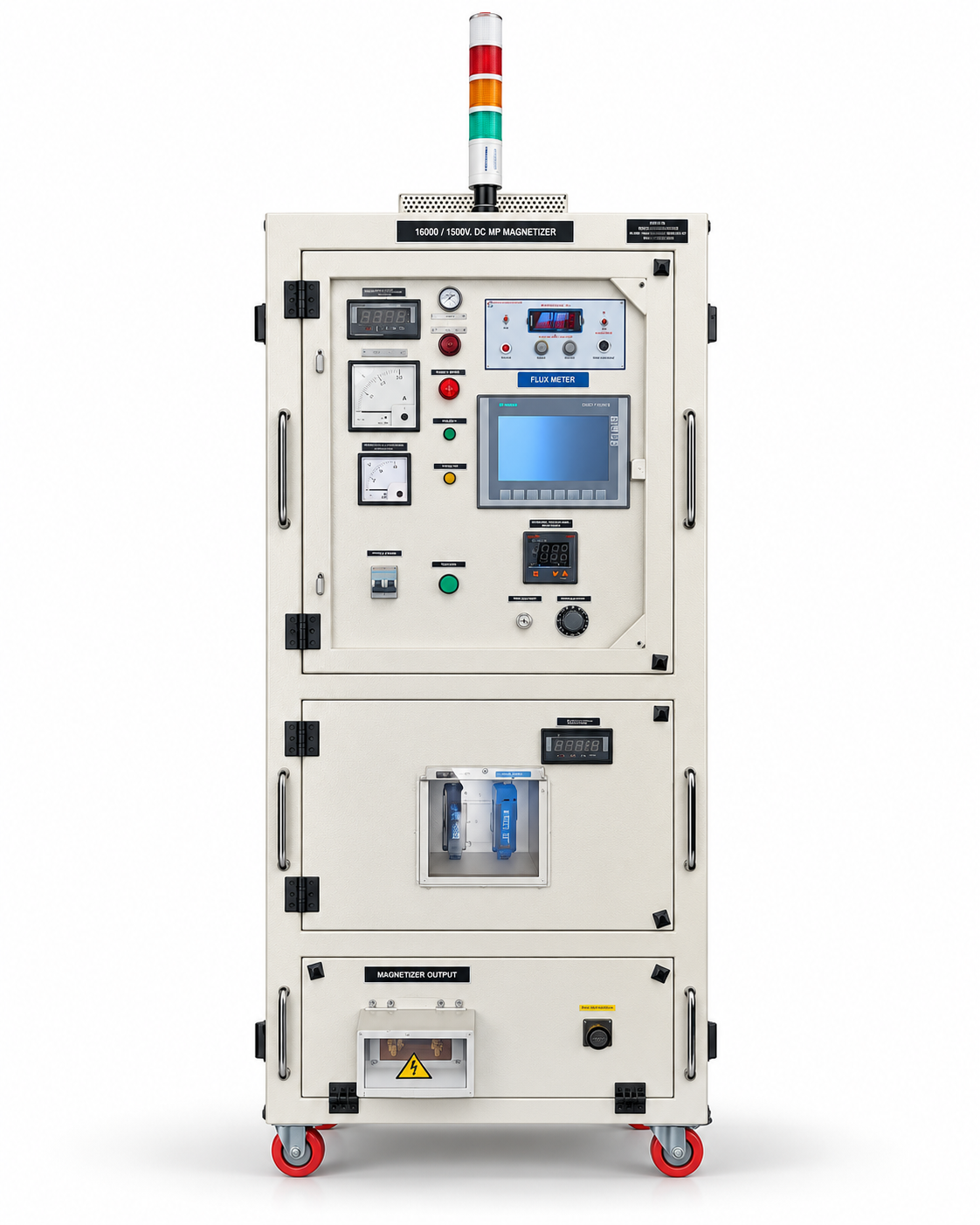
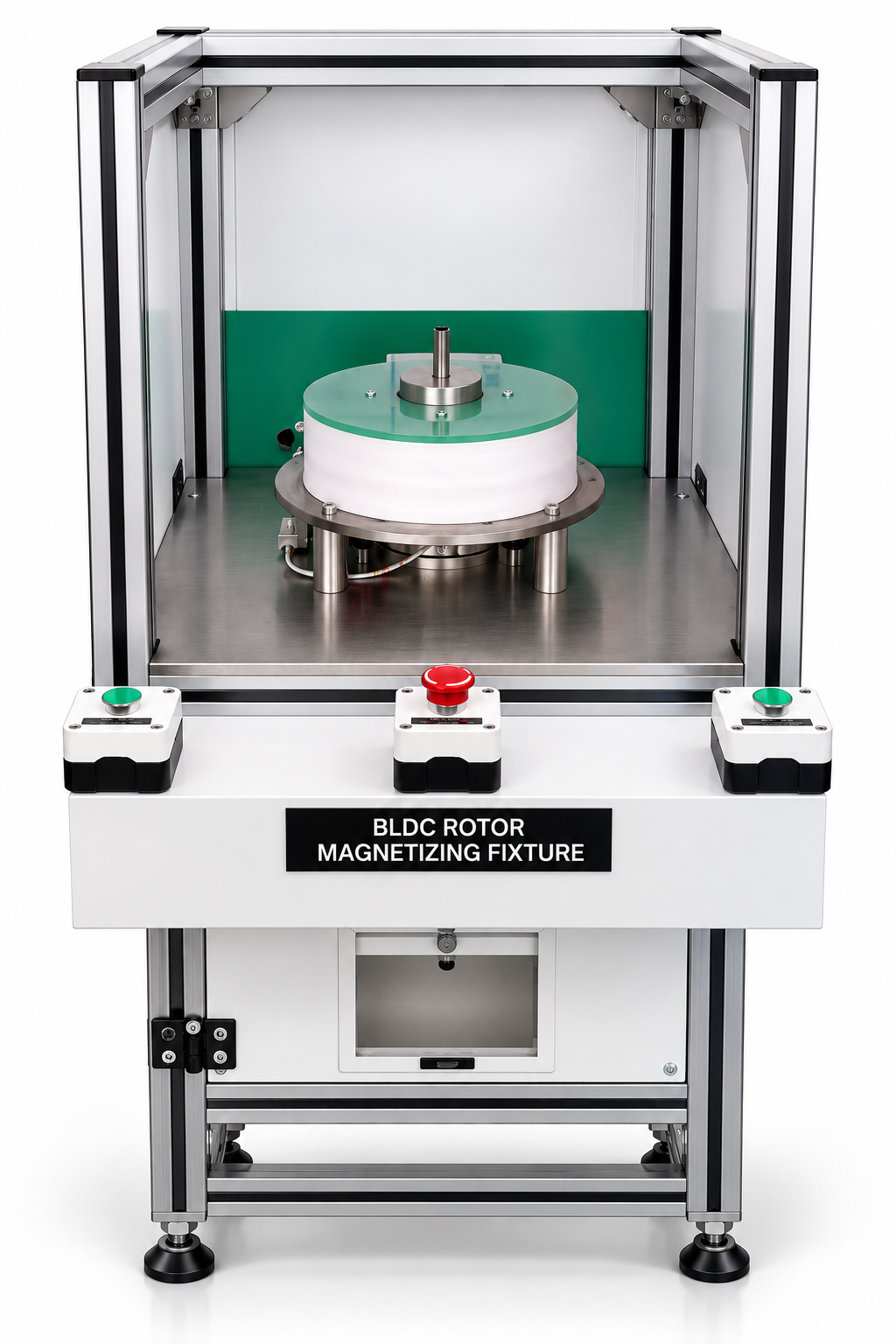
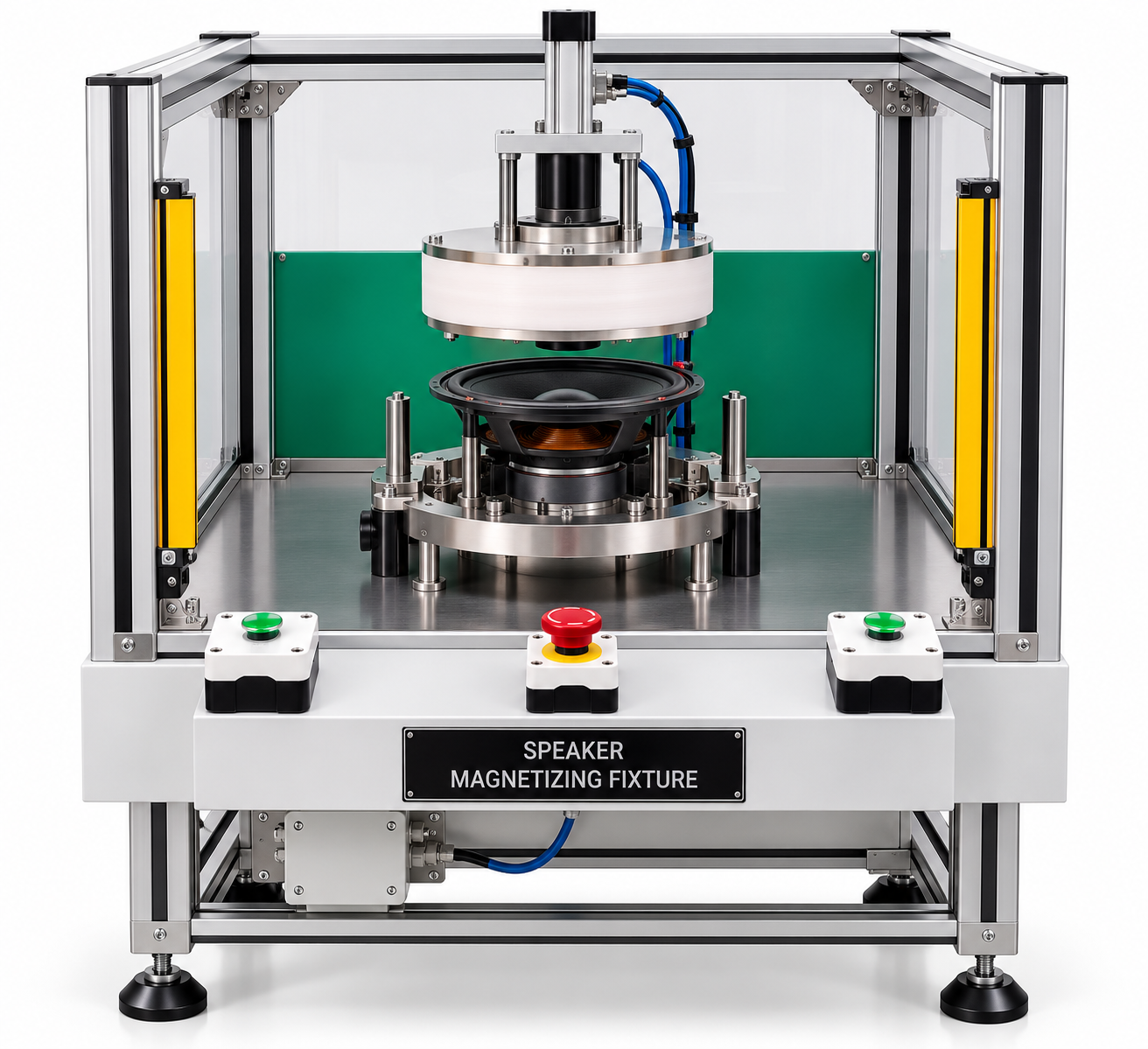
“What does a magnet charging machine cost?” is one of the first questions buyers ask, and the honest answer is that it depends on what the machine has to do. A compact unit for small ferrite magnets and a production system for NdFeB motor rotors go by the same name, yet they share little beyond the operating principle. This guide explains what decides the cost, so you can compare quotations on equal terms.
Key takeaways
- There is no catalogue price for an industrial magnetizer, because the machine, fixture and controls are sized around your part.
- Energy rating and maximum voltage set the size of the capacitor bank, charger and switching — usually the biggest single cost factor.
- Part-specific fixtures, cooling for fast cycle times, monitoring and automation each add to the price.
- Installation, operator training and spares belong in the total cost, even when they are quoted separately.
- The best comparison is cost per correctly magnetized part, not the machine price alone.
Why there is no single price
A capacitor discharge magnetizer — also called an impulse magnetizer — is a system rather than a box. It combines a charger, a capacitor bank, a high-current switch, a coil or fixture, and the controls that tie them together. Each of these is chosen for the job. If you are new to the principle, how a capacitor discharge magnetizer works explains the building blocks.
Two machines with the same energy rating can still differ widely in price. One might have a basic push-button panel and a standard coil; the other might add a water-cooled rotor fixture, peak-current monitoring with data logging, and a PLC link to an assembly line.
The main cost drivers
| Cost driver | What it covers | Why it changes the price |
|---|---|---|
| Energy rating | Stored energy in kilojoules | Larger capacitor banks and chargers cost more |
| Maximum voltage | Charging voltage range | Capacitors, switches, cables and insulation must be rated for it |
| Coil or fixture | Solenoid coil or part-specific fixture | Rotor, housing and multi-pole fixtures need design and precision machining |
| Cooling and cycle time | Charger power and fixture cooling | Faster cycles need more charging power and forced-air or water cooling |
| Controls and monitoring | Voltage setting, peak-current check, logging | More measurement and traceability add hardware and software |
| Automation | Loading, part detection, reject handling, PLC | Adds mechanical, electrical and engineering work |
| Installation and support | Commissioning, training, spares | Part of the total project cost |
Energy rating and voltage
The energy rating has to be high enough to saturate your most demanding part through the chosen fixture. NdFeB needs a much stronger field than ferrite, and large parts, batches and multi-pole patterns all push the requirement up. Our guide to magnetizer field requirements gives approximate figures for each material. Voltage and energy go together: a higher-voltage machine needs components rated for that voltage throughout.
It is also worth allowing a sensible margin. A machine sized exactly for today’s part may not cope with a larger rotor or a higher-grade magnet next year, while a moderate margin lets the same machine take on new fixtures later.
Coil or fixture
A plain solenoid magnetizer coil for loose magnets is the simplest tooling. Rotor, motor housing and multi-pole fixtures are designed for one part and machined to its drawing, so they cost more, and each additional part design usually needs its own fixture.
Cooling and cycle time
Every pulse leaves heat in the fixture winding. A laboratory machine fired a few times an hour needs no special cooling, while a fan or motor line that magnetizes parts continuously may need a larger charger plus forced-air or water cooling to keep pace. A larger charger can also call for a three-phase supply, so check the connection available at your site early.
Controls, monitoring and automation
Peak-current monitoring confirms that every part received a full pulse, and logging gives traceability. Automatic loading, part detection and a PLC interface remove handling time on high-volume lines. These options raise the price but can lower the cost per good part.
Installation, training and support
Commissioning, operator training, recommended spares and after-sales support should all be clear in the quotation. They affect both the first cost and how smoothly the machine runs over its life.
How the application shifts the cost
The application often decides which of these factors matter most. A rotor magnetizer for BLDC fans or hub motors is dominated by fixture design, pole accuracy and cycle time. A speaker magnetizer depends heavily on the largest magnet circuit and whether neodymium drivers are included. A general-purpose magnet charging machine for loose magnets is driven mainly by energy rating and coil size.
Comparing quotations fairly
When quotations arrive, check them against the same requirement:
- Has each supplier confirmed that the proposed energy and fixture will saturate your hardest part?
- Is the fixture included, and is its expected duty at your production rate stated?
- Are cooling, monitoring and safety interlocks included or optional extras?
- Do installation, training and spares appear in the scope?
- What warranty and service support are offered?
A lower price that leaves parts under-magnetized, or a fixture that overheats at your line rate, quickly costs more in rejects and downtime. Our guide on how to choose a magnetizer covers sizing in more depth.
Need help choosing?
Send your part drawing, magnet material and grade, pole pattern, output per shift and power supply details, and the SK Enterprises team will propose a configuration and prepare a quotation for it.
Request a quotation or contact us to discuss your requirement.