SK Enterprises Manufacturer of Industrial Magnetizers & Magnetic Instruments — Maharashtra, India

Magnetizer Fixtures, Coils & Yokes

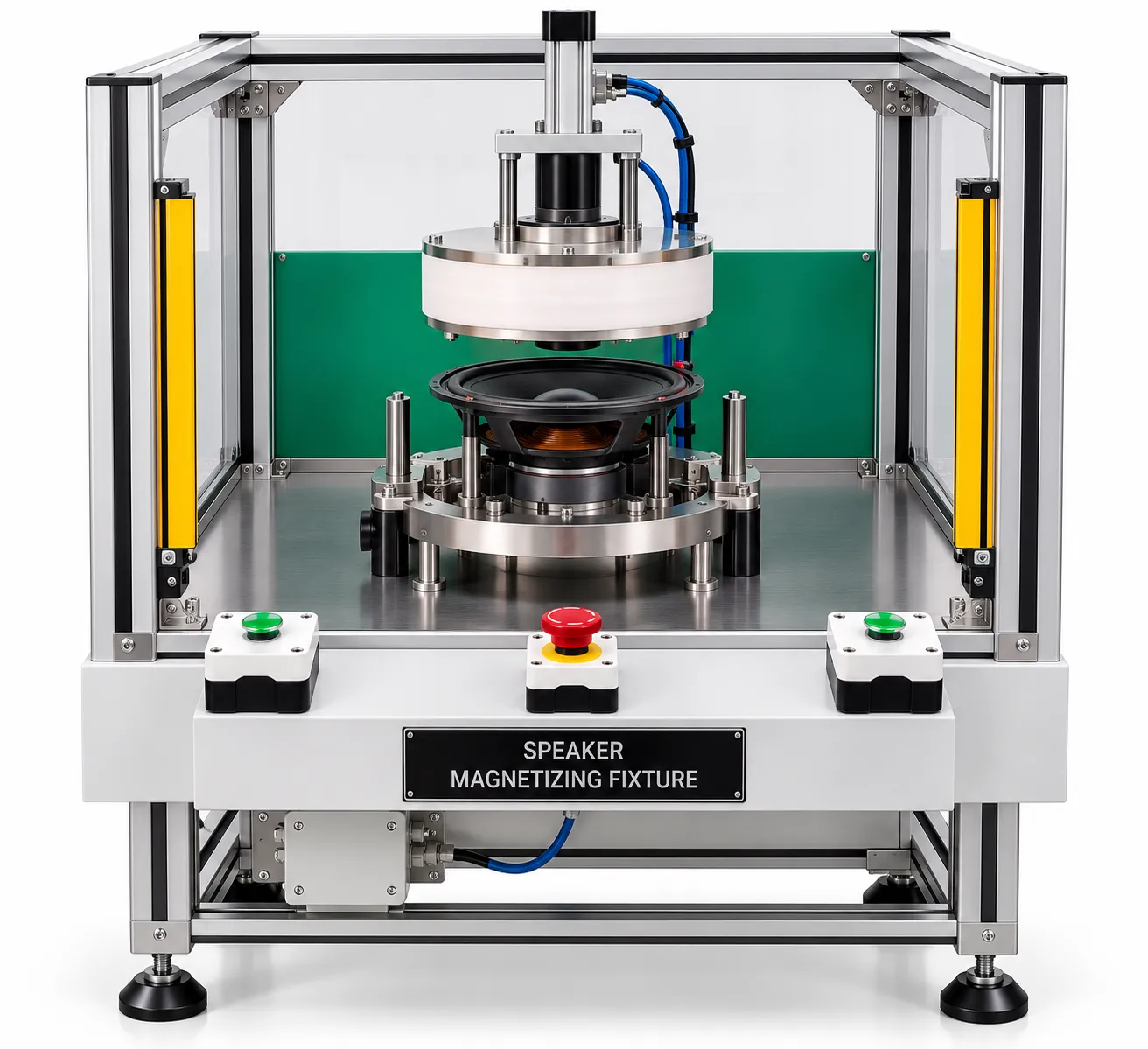
Speaker Magnetizer (Speaker Magnet Charging Fixture)

A speaker magnetizer machine charges the magnet inside a speaker's motor assembly — the magnet, the back plate with its pole piece, and the top plate — once the parts have been glued and centred. Building speakers with an unmagnetized magnet keeps steel particles out of the voice-coil gap and makes the assembly far easier to handle. SK Enterprises manufactures speaker magnetizers and matching fixtures in Maharashtra for audio manufacturers across India.

  • Magnetizes external ferrite ring and internal neodymium speaker designs
  • Suits the magnet circuit alone or the complete driver, depending on fixture
  • Fixtures sized to the yoke, top plate and frame of your speaker
  • Assemble unmagnetized for a cleaner voice-coil gap
Magnetized part
Assembled speaker magnet circuit
Operating principle
Capacitor discharge pulse through a speaker magnetizer fixture
Magnetization direction
Axial, through the magnet thickness, with the steel plates in place
  • Direct from manufacturer
  • Built to your part
  • Application support

Product overview

About Speaker Magnetizer Fixture

How a speaker magnetizer works

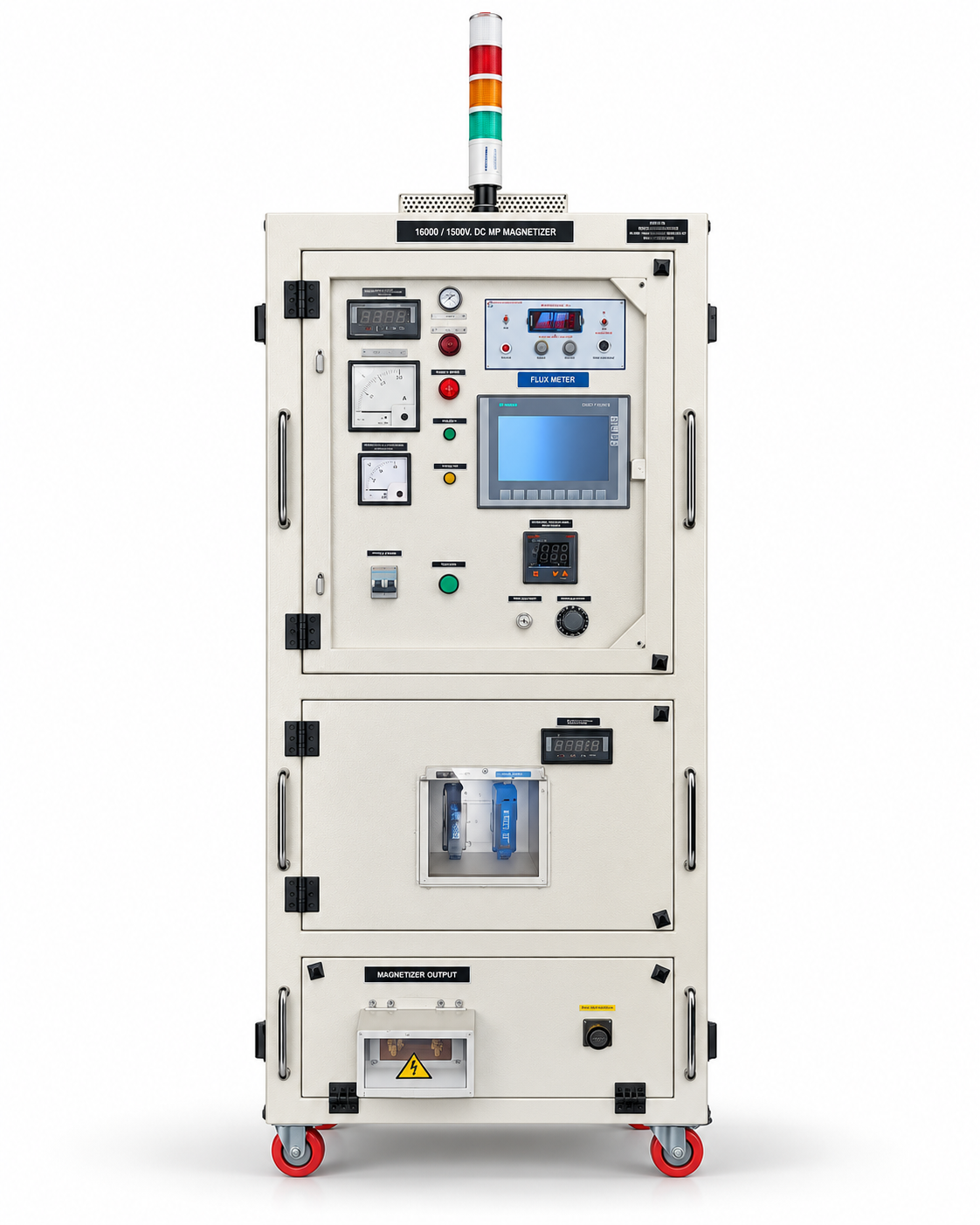
The motor of a loudspeaker is a small magnetic circuit: the magnet, a back plate with its centre pole piece, and a top plate. Together they concentrate flux into the narrow gap where the voice coil moves. In production these parts are glued and centred while the magnet is still unmagnetized. The finished assembly — or the complete driver — then goes into a fixture connected to a capacitive discharge impulse magnetizer, and a single pulse lasting a few milliseconds magnetizes the magnet through its thickness.

The steel plates sit in the field path during the pulse, so the fixture has to be designed around the whole assembly rather than the bare magnet. In other words, a speaker magnet charging machine is really a matched pair of machine and fixture. If the principle is new to you, read how a capacitor discharge magnetizer works.

External and internal magnet speakers

External-magnet design Internal-magnet design
Typical magnet Ferrite ring NdFeB disc or ring (occasionally ferrite)
Magnet position Outside the voice coil, between back plate and top plate Inside a steel cup, beneath the pole plate
Approx. field to saturate 1–1.5 T 2.5–3.5 T for NdFeB
Common products Woofers, PA, car audio and multimedia drivers Tweeters, compact and lightweight drivers
Fixture notes Field applied through the ring magnet and its plates Field has to be driven through the surrounding steel cup

Because neodymium needs a much higher field, a line that runs both designs should be sized for the NdFeB parts, usually with a separate fixture for each magnet circuit size.

Why audio manufacturers magnetize after assembly

  • A clean voice-coil gap. A magnetized assembly pulls in steel dust and swarf, and particles in the gap are a common cause of rubbing and buzzing. Unmagnetized parts stay clean until the last step.
  • Easier gluing and centring. Plates and magnet do not jump together while the adhesive is wet, so the gap stays concentric.
  • Simpler handling. Unmagnetized motor assemblies can be stacked, stored and moved between workstations without sticking to each other or to tooling.

Setting up a speaker magnetizer station

Fixture and location

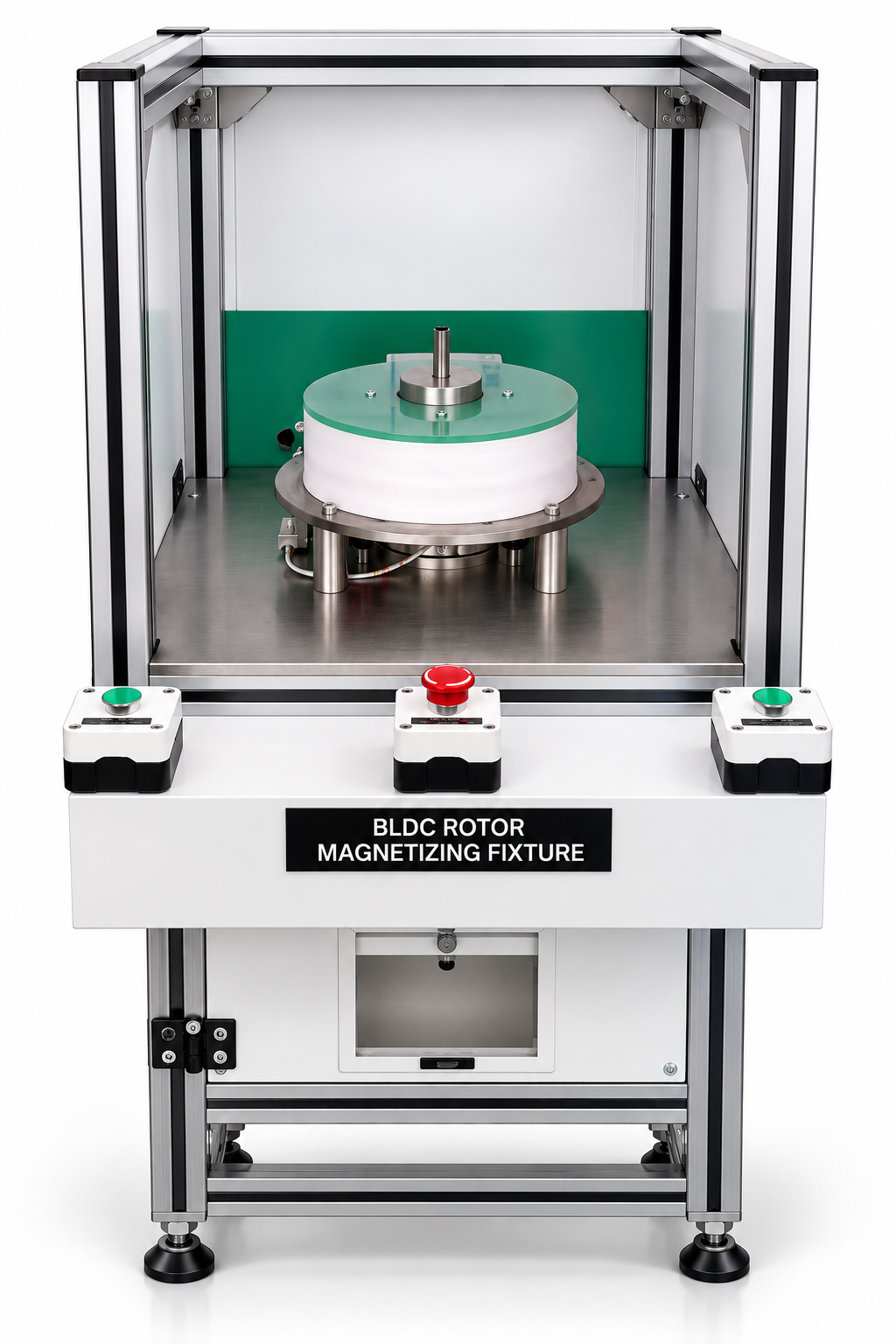
The fixture locates the assembly concentrically and supports it against the forces of the pulse. Complete-driver fixtures also need clearance for the frame and cone, so they are designed from the full speaker drawing.

Energy and cycle rate

Energy is chosen for the largest and most demanding magnet circuit on the line. Cycle rate then depends on capacitor recharge time and how much heat the fixture can shed between pulses.

Checking the result

A gaussmeter probe in the gap gives a direct reading of gap flux density that can be compared with a reference speaker, while peak-current monitoring confirms every assembly received a full pulse. With a suitable fixture, the same setup can also handle recharging weakened speaker magnets, as with older alnico drivers.

Speaker magnetizers made in Maharashtra, India

SK Enterprises manufactures speaker magnetizers and fixtures as part of its range of industrial magnetizer machines, for audio and automotive speaker producers in Maharashtra and across India.

What decides the price of a speaker magnetizer?

Each speaker magnetizer is sized for the magnet circuits it will charge, so the price is worked out from your requirement rather than taken from a list. The main cost drivers are:

Cost driver How it affects the price
Energy rating Large ferrite woofer circuits and neodymium drivers need more stored energy than small multimedia speakers.
Voltage Higher charging voltage needs capacitors, switching, cables and fixture insulation rated to match.
Fixture design Magnet-circuit fixtures are simpler than complete-driver fixtures with clearance for the frame and cone; each speaker size usually needs its own fixture or insert.
Cooling and cycle time High-volume lines need faster recharging and forced-air or water cooling so the fixture keeps pace.
Controls and monitoring Peak-current monitoring, data logging and a gaussmeter station for gap flux checks add to the basic machine.
Automation Conveyor or automatic loading and links to the assembly line add hardware and engineering.
Installation Commissioning, operator training and recommended spares are part of the total cost.

The machine that suits a multimedia speaker line is very different from one for large PA woofers or neodymium tweeters, which is why it pays to specify the most demanding magnet circuit you plan to run.

Share your magnet circuit drawing, magnet material and hourly output, and we will recommend a configuration and quote a price. Request a quotation for a speaker magnetizer.

Specifications

Speaker Magnetizer Fixture specifications

Typical technical specifications
Operating principle Capacitor discharge pulse through a speaker magnetizer fixture
Magnetization direction Axial, through the magnet thickness, with the steel plates in place
Speaker designs External-magnet (ferrite ring) and internal-magnet (NdFeB or ferrite disc in a steel cup)
Typical field to saturate Approx. 1 – 1.5 T for ferrite and 2.5 – 3.5 T for NdFeB (grade dependent)
Pulse Commonly a single pulse of a few milliseconds per assembly
Fixture Sized to the magnet circuit diameter and height, with clearance for frame and cone where needed
Cycle rate Set by capacitor recharge time and fixture cooling
Quality checks Gap flux density measured with a gaussmeter probe; peak-current monitoring

Typical values for this product type, for reference. Exact values depend on grade, size and design — confirm with our team before ordering.

Models & supply from SK Enterprises
Speaker sizes supported On request
Magnet types On request
Magnetizer energy ratings On request
Fixture options On request
Gap flux checking On request
Warranty On request
Lead time On request

Sizes & variants

Common types and variants

Magnet-circuit magnetizers

To magnetize the motor assembly — magnet, plates and pole piece — before it is joined to the frame and cone.

Complete-driver magnetizers

Fixtures with clearance for the basket and cone, so the finished speaker is magnetized as the last step.

Ferrite speaker setups

Sized for external ring-magnet circuits used in woofers, mid-range, PA and multimedia drivers.

Neodymium speaker setups

Higher field and energy for compact internal-magnet drivers, tweeters and lightweight car audio speakers.

Applications

Applications of Speaker Magnetizer Fixture

  • Woofers and PA drivers

    Large ferrite ring magnet circuits magnetized after gluing and centring.

  • Car audio speakers

    Ferrite and neodymium drivers for vehicle fitment and aftermarket audio.

  • Multimedia and TV speakers

    Small drivers produced in high volumes, where cycle time matters.

  • Tweeters and compact drivers

    Neodymium internal-magnet designs that need a strong magnetizer field.

  • Service re-magnetization

    Recharging speaker magnets that have weakened, such as in older alnico drivers.

Features & benefits

Speaker Magnetizer Fixture features & benefits

Key features

  • Fixture shaped to your speaker Locates the magnet circuit concentrically and supports it against the forces of the pulse.
  • Energy matched to the magnet Machine energy and fixture design are chosen for ferrite or neodymium magnet circuits.
  • Repeatable charging The same voltage setting gives the same pulse, so gap flux stays consistent from one driver to the next.
  • Operator protection Enclosed fixtures and controlled firing keep the operator away from the pulse.

Benefits for your business

  • Cleaner voice-coil gap Unmagnetized parts do not pull steel particles into the gap, a common cause of rub and buzz.
  • Easier gluing and centring Plates and magnet do not snap together while the adhesive is wet, so the gap stays centred.
  • Simpler storage and transport Unmagnetized motor assemblies can be stacked and moved without sticking to each other or to tooling.
  • Consistent sensitivity Fully saturated magnet circuits give consistent gap flux, helping keep sensitivity within tolerance.

Industries served

Industries that use Speaker Magnetizer Fixture

Get the right Speaker Magnetizer Fixture for your application

Send your part drawing, magnet material and output per shift. Our engineers will recommend the right configuration and send a quotation.

FAQs

Speaker Magnetizer Fixture — frequently asked questions

Why are loudspeakers magnetized after assembly?

A magnetized assembly attracts steel dust and swarf, and particles in the voice-coil gap cause rubbing and buzzing. Assembling unmagnetized parts also makes gluing and centring easier, because the plates and magnet do not pull together while the adhesive cures.

Can ferrite and neodymium speakers be magnetized on the same machine?

Usually yes, provided the machine has enough energy and voltage for the neodymium assemblies, which need a much higher field than ferrite. Each magnet circuit size normally has its own fixture.

Do I need a different fixture for every speaker model?

Not always. The fixture is sized to the magnet circuit, so speakers that share the same magnet, yoke and plate dimensions can often share a fixture even if their cones or frames differ, provided there is clearance for the frame.

How do we check that a speaker is fully magnetized?

Measure the flux density in the gap with a gaussmeter probe and compare it with a reference speaker of the same model. Peak-current monitoring on the magnetizer adds a check that every assembly received a full pulse.

Can old or weakened speakers be re-magnetized?

Speakers whose magnets have lost strength — most often older alnico designs — can usually be re-magnetized in a suitable fixture, as long as the magnet is not cracked or damaged.

What is the price of a speaker magnetizer machine in India?

There is no fixed price, because each machine is sized for the speakers it will magnetize. The cost depends on the largest magnet circuit you produce, ferrite or neodymium magnets, the number of fixtures, cooling and cycle rate, gap flux checking, any automation and installation. Send the magnet circuit drawing and hourly output for a quotation.

Related products

All products

Knowledge centre

Guides about Speaker Magnetizer Fixture

Get a quote

Request details for Speaker Magnetizer Fixture

Fill in what you know — our team will follow up with a recommended configuration, price and delivery time.

We’ll call or WhatsApp you on this number.
PDF, Word, Excel or image — max 5 MB.

Prefer to talk?

Call or WhatsApp us with your requirement — we’ll help you choose the right magnetizer and fixture.

WhatsApp Us