SK Enterprises Manufacturer of Industrial Magnetizers & Magnetic Instruments — Maharashtra, India

Magnetizer Machines

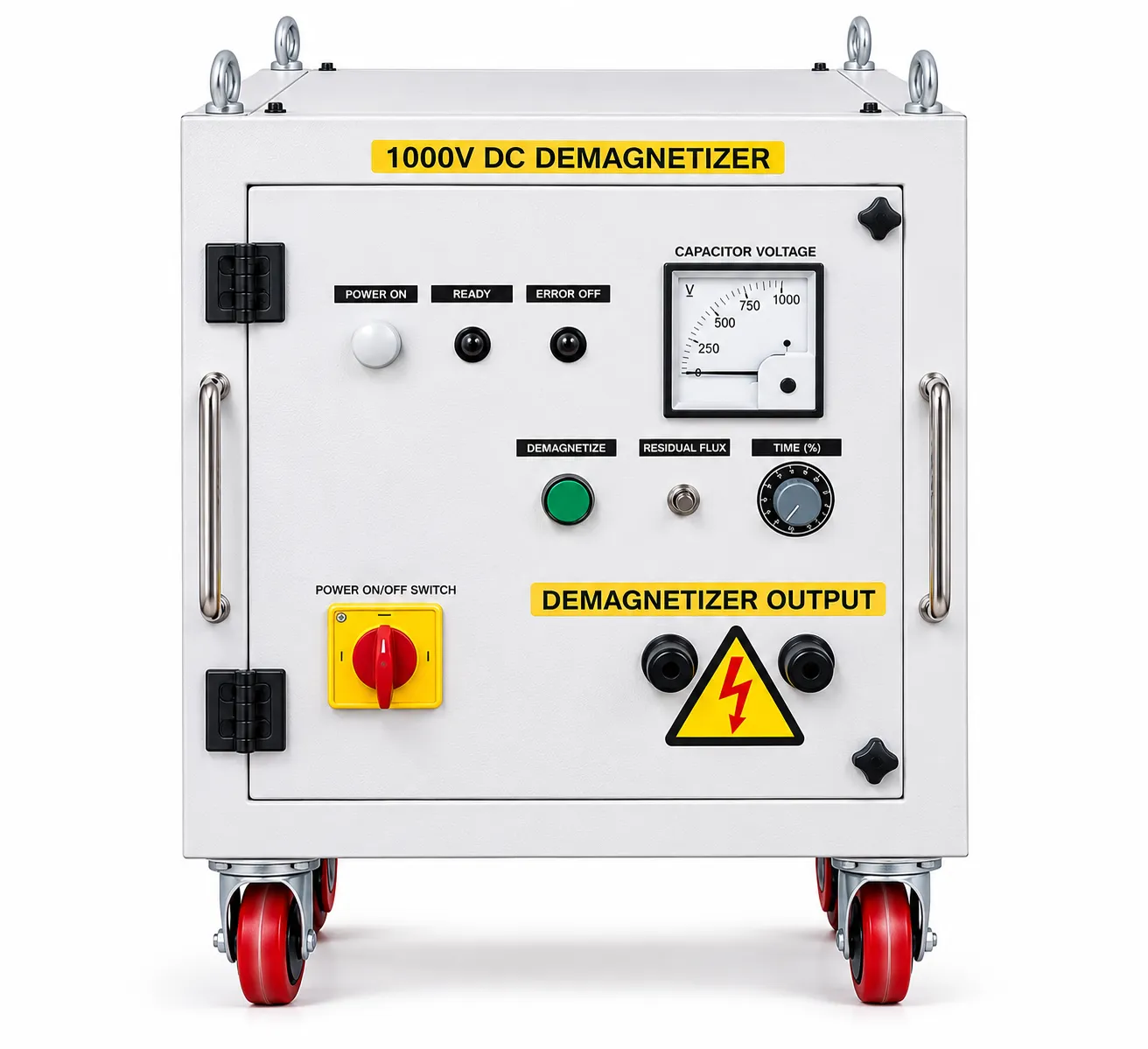
Capacitive Discharge Impulse Demagnetizer

A capacitive discharge impulse demagnetizer stores energy in a capacitor bank, like a magnetizer, but releases it through the coil as an alternating pulse that dies away. The magnetic field reverses direction again and again, each time a little weaker, so the magnet or part is taken down to a low residual level instead of being saturated. SK Enterprises manufactures impulse demagnetizers in Maharashtra for magnet makers and for motor and assembly manufacturers who need to correct, rework or test magnetized parts.

  • Removes magnetization from magnets, magnetized assemblies and steel parts
  • Alternating field that decays to near zero for a low, even residual level
  • Adjustable charging voltage to suit the part and magnet grade
  • Built-in safety interlocks and automatic capacitor discharge
Demagnetization method
Decaying alternating impulse
Operating principle
Capacitor bank discharged through the coil as a damped, alternating current
Field
Reverses polarity with decreasing strength until it dies away
  • Direct from manufacturer
  • Built to your part
  • Application support

Product overview

About Capacitive Discharge Impulse Demagnetizer

What is a capacitive discharge impulse demagnetizer?

A capacitive discharge (CD) impulse demagnetizer is built on the same principle as a capacitive discharge impulse magnetizer. A bank of capacitors is charged to a set voltage and then discharged through a coil. The difference is the shape of the pulse. A magnetizer sends a single pulse in one direction to saturate the magnet. A demagnetizer lets the current swing back and forth, so the field reverses polarity again and again while it dies away.

How the decaying pulse removes magnetization

Each reversal of the field drives the magnet a little way in the opposite direction, and each one is weaker than the one before. The magnetization follows the field down until almost nothing is left. Because the whole process takes only a fraction of a second, the part is left at a low, even residual level, ready to be reworked, tested or magnetized again.

The first reversals must be strong enough to overcome the magnet’s coercivity. That is why high-coercivity materials such as NdFeB need a machine and coil with enough energy, while ferrite and alnico parts need much less.

Where manufacturers use a demagnetizer

  • Correcting mistakes: a rotor or housing magnetized with the wrong pole pattern can be demagnetized and magnetized again instead of being scrapped.
  • Rework: unmagnetized assemblies are easier and safer to take apart, clean and rebuild.
  • Testing: samples can be returned to a known starting state before each measurement or magnetizer trial.
  • Steel parts and tooling: residual magnetism is removed so chips and dust do not cling to the part.

Choosing a demagnetizer

Energy and voltage

The machine needs enough energy and voltage to reverse the magnetization of your most demanding part. Larger parts and higher-coercivity magnets need more.

Coil size

The part has to fit inside the coil, and a closely matched coil uses the energy more effectively. Rotors and housings may need a coil or fixture designed around the part.

Checking the result

Measure the residual field with a gaussmeter or flux meter so you know each batch has been demagnetized to the level you need.

Built by SK Enterprises in Maharashtra

SK Enterprises designs and manufactures demagnetizers alongside its magnetizers, coils and fixtures. Tell us what you need to demagnetize, the magnet material and grade, and the part size, and we will recommend a machine and coil. Request a quotation for an impulse demagnetizer.

Specifications

Capacitive Discharge Impulse Demagnetizer specifications

Typical technical specifications
Operating principle Capacitor bank discharged through the coil as a damped, alternating current
Field Reverses polarity with decreasing strength until it dies away
Stored energy Typically a few kJ to 20 kJ or more, depending on model
Charging voltage Typically adjustable, commonly up to 1,000 – 3,000 V
Materials Ferrite, alnico, SmCo and NdFeB magnets; hardened steel parts (energy and coil dependent)
Input supply Single-phase 230 V or three-phase 415 V, 50 Hz (model dependent)
Controls Voltage setting, charge / fire controls, safety interlocks

Typical values for this product type, for reference. Exact values depend on grade, size and design — confirm with our team before ordering.

Models & supply from SK Enterprises
Models / energy ratings On request
Coils supplied On request
Combined magnetizer / demagnetizer On request
Input supply options On request
Installation & training On request
Warranty On request
Lead time On request

Sizes & variants

Common types and variants

Bench-top demagnetizers

Compact units for laboratories, quality control and small magnets or parts.

Production demagnetizers

Higher-energy machines with coils sized for rotors, housings and larger assemblies in regular shop-floor use.

Magnetizer–demagnetizer combinations

One machine that can magnetize or demagnetize, chosen for each job.

Applications

Applications of Capacitive Discharge Impulse Demagnetizer

  • Correcting magnetization errors

    Demagnetize rotors, housings or magnets magnetized with the wrong pole pattern or polarity, then magnetize them again correctly.

  • Rework and repair

    Demagnetize assemblies so magnets can be removed, parts reworked and steel debris cleaned off safely.

  • Testing and quality control

    Return samples to a known, unmagnetized state before measuring them or repeating a magnetizer trial.

  • Steel parts and tooling

    Remove residual magnetism from hardened steel parts, tools and dies so chips and dust do not stick to them.

  • Magnet recycling and shipping

    Demagnetize magnets and assemblies before disassembly, recycling or transport.

Features & benefits

Capacitive Discharge Impulse Demagnetizer features & benefits

Key features

  • Decaying alternating field Every reversal is weaker than the one before, so parts are left with a low, even residual level.
  • Adjustable energy Set the charging voltage to the part, from small magnets to large assemblies.
  • Safety by design Interlocked operation and automatic discharge of the capacitor bank protect the operator.
  • Built for the shop floor Robust construction for daily industrial use.

Benefits for your business

  • Save rejected parts Demagnetize and re-magnetize wrongly magnetized rotors and assemblies instead of scrapping them.
  • Safer handling Unmagnetized parts do not snap together or pick up steel swarf during rework and assembly.
  • Reliable test results Start every measurement or magnetizer trial from the same, demagnetized state.
  • Direct from the manufacturer Work with the team that builds the machine for configuration, spares and support.

Industries served

Industries that use Capacitive Discharge Impulse Demagnetizer

Get the right Capacitive Discharge Impulse Demagnetizer for your application

Send your part drawing, magnet material and output per shift. Our engineers will recommend the right configuration and send a quotation.

FAQs

Capacitive Discharge Impulse Demagnetizer — frequently asked questions

What is an impulse demagnetizer?

It is a machine that removes magnetization from permanent magnets, magnetized assemblies and steel parts. A capacitive discharge model stores energy in capacitors and releases it through a coil as an alternating pulse that dies away, taking the part down to a low residual level.

How is a demagnetizer different from a magnetizer?

A magnetizer sends one strong pulse in one direction to saturate the magnet. A demagnetizer reverses the field again and again while it fades, so the magnetization is cancelled instead of set.

Can it demagnetize NdFeB magnets?

NdFeB has very high coercivity, so the first reversals of the field must be about as strong as the field used to magnetize it. With enough energy and a suitable coil this is possible. Share the magnet grade and size and we will confirm the right machine and coil.

How do I check that a part is demagnetized?

Measure the residual field on the part with a gaussmeter or flux meter before and after demagnetization. Repeat on a few parts from each batch to confirm the result is consistent.

What is the price of an impulse demagnetizer?

There is no fixed list price, because each machine is configured for the parts it will demagnetize. The price depends mainly on the energy rating, maximum voltage, coil size, controls and any automation. Send your part details and quantities and we will quote for the right configuration.

Related products

All products

Get a quote

Request details for Capacitive Discharge Impulse Demagnetizer

Fill in what you know — our team will follow up with a recommended configuration, price and delivery time.

We’ll call or WhatsApp you on this number.
PDF, Word, Excel or image — max 5 MB.

Prefer to talk?

Call or WhatsApp us with your requirement — we’ll help you choose the right magnetizer and fixture.

WhatsApp Us