SK Enterprises Manufacturer of Industrial Magnetizers & Magnetic Instruments — Maharashtra, India

Testing & Measuring Instruments

Digital Gauss Meter (Hall Effect Gaussmeter)

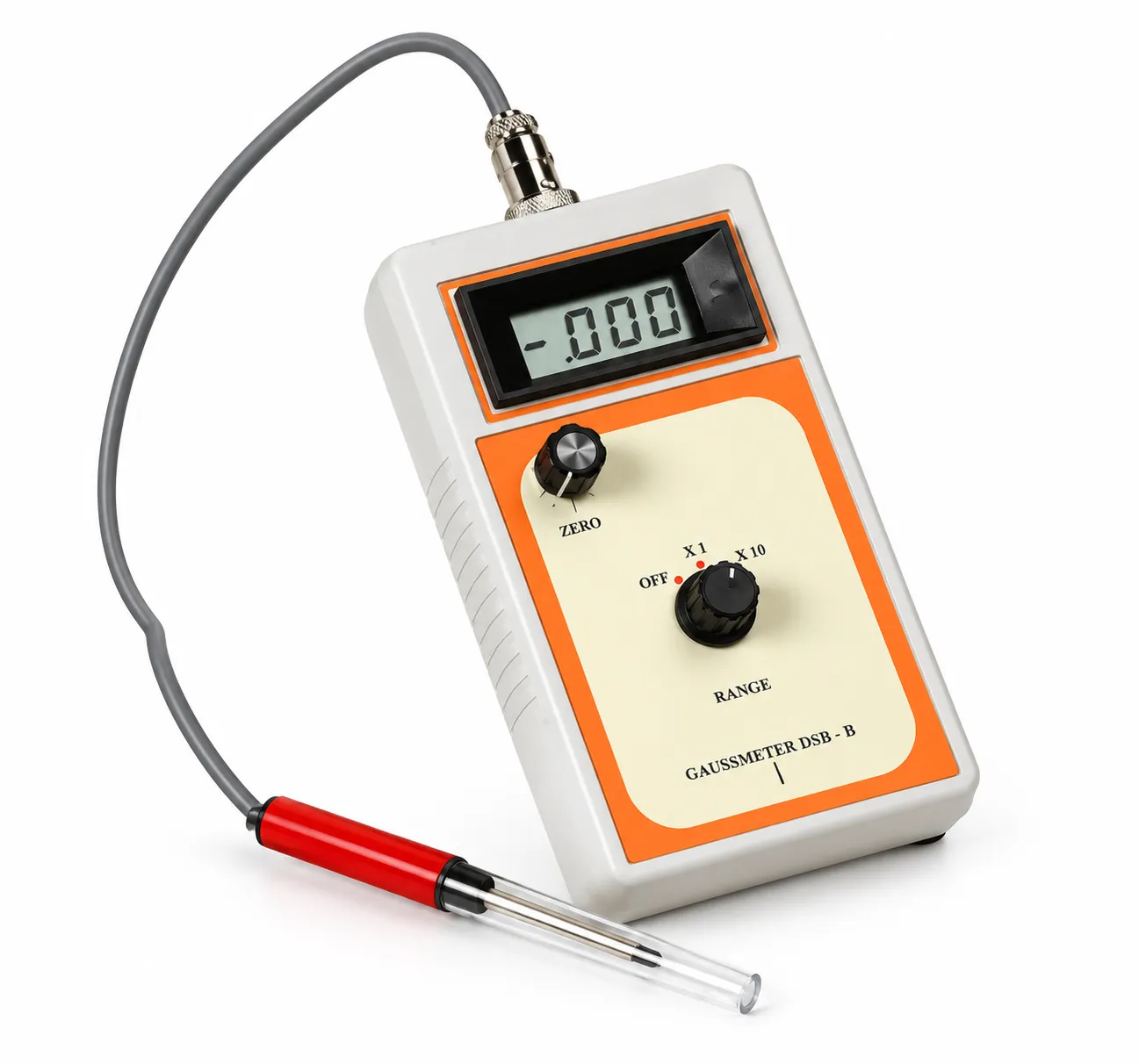
A digital gaussmeter — also called a gauss meter or tesla meter — measures magnetic flux density — the strength of a magnetic field at one point — with a Hall-effect probe. Hold the probe on or near a magnet, in an air gap or inside a coil, and the meter shows the reading in gauss, millitesla or tesla together with its polarity, north or south. SK Enterprises manufactures digital gaussmeters for magnet makers, motor and loudspeaker manufacturers and quality laboratories.

  • Measures magnetic flux density with a Hall-effect probe
  • Reads in gauss, millitesla or tesla, with north / south polarity
  • Checks surface field, pole patterns and residual magnetism
  • Digital display for quick, repeatable readings
Measures
Flux density (G / mT / T)
Sensor
Hall-effect probe
Units
Gauss (G), millitesla (mT), tesla (T) — 1 T = 10,000 G
  • Direct from manufacturer
  • Built to your part
  • Application support

Product overview

About Digital Gaussmeter

How a digital gaussmeter works

The probe carries a small Hall-effect sensor: a thin semiconductor element with a small current flowing through it. When a magnetic field passes through the element, it produces a voltage proportional to the field. The meter amplifies that voltage and shows it as flux density in gauss, millitesla or tesla. Because the voltage changes sign when the field reverses, the meter also shows whether the probe is facing a north or a south pole.

Transverse and axial probes

  • A transverse probe is flat, with the sensor at its tip. It measures fields that pass through the flat face — on the surface of a magnet, between pole pieces or in a narrow air gap.
  • An axial probe measures fields along its length, such as the field inside a solenoid or a magnetizer coil.

Getting repeatable readings

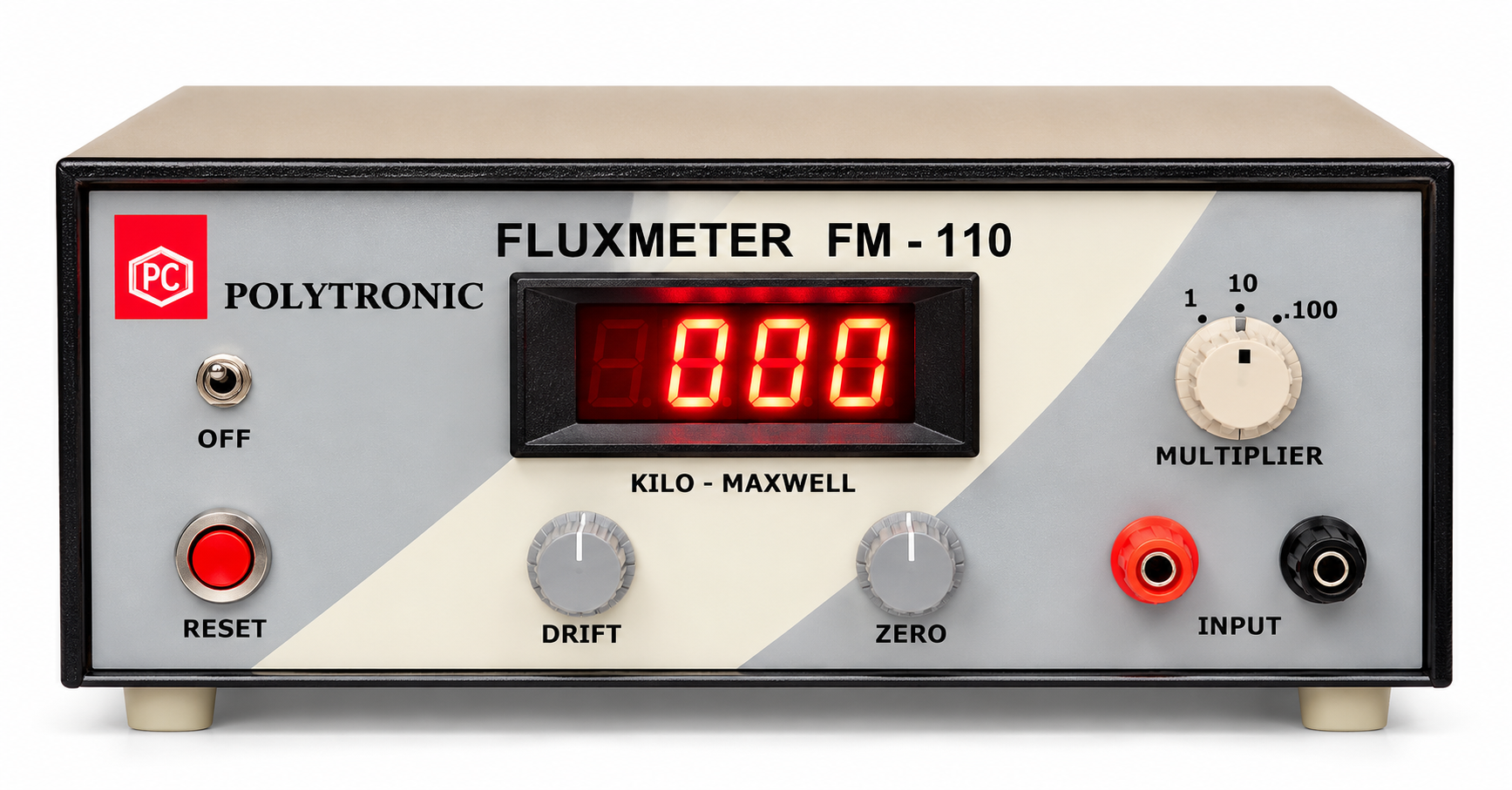
Gaussmeter readings depend on where and how the probe is held. Measure at the same point, at the same angle and at the same distance from the surface each time, ideally using a fixture. The field of a magnet also changes with temperature, so measure parts at a similar temperature when comparing batches. To compare the overall strength of whole magnets, a digital fluxmeter is often the better tool.

Made by SK Enterprises

SK Enterprises manufactures digital gaussmeters for production lines, goods inward and laboratories. Tell us what you need to measure, the field range and the size of your parts, and we will recommend a model and probe. Request a quotation for a digital gaussmeter.

Specifications

Digital Gaussmeter specifications

Typical technical specifications
Sensor Hall-effect probe
Measures Magnetic flux density (B) at the probe tip
Units Gauss (G), millitesla (mT), tesla (T) — 1 T = 10,000 G
Measurement modes DC (static) fields; AC fields and peak hold on many models
Typical range Up to about 2 – 3 T (20,000 – 30,000 G), model dependent
Probes Transverse (flat) probe for surfaces and gaps; axial probe for coil bores
Display Digital, with polarity indication

Typical values for this product type, for reference. Exact values depend on grade, size and design — confirm with our team before ordering.

Models & supply from SK Enterprises
Models and ranges On request
Accuracy On request
Probes supplied On request
Power supply On request
Data output On request
Calibration On request
Warranty On request
Lead time On request

Sizes & variants

Common types and variants

Handheld gaussmeters

Portable meters for checking magnets on the shop floor or at goods inward.

Bench gaussmeters

Desktop meters for laboratories and quality control, often with higher resolution and data output.

Built-in gaussmeters

Meters fitted into a magnetizer or test station to check parts in production.

Applications

Applications of Digital Gaussmeter

  • Incoming magnet inspection

    Check the surface field of ferrite and NdFeB magnets from suppliers against your specification.

  • After magnetization

    Confirm that rotors, housings and loose magnets are magnetized and that the pole pattern and polarity are correct.

  • Residual magnetism

    Measure what is left on steel parts or magnets after demagnetization.

  • Air gaps and coils

    Measure the field in a loudspeaker gap, between pole pieces or inside a magnetizer coil.

Features & benefits

Digital Gaussmeter features & benefits

Key features

  • Hall-effect sensing A small sensor at the probe tip measures the field at a precise point.
  • Polarity indication The sign of the reading shows whether the probe is at a north or a south pole.
  • Clear digital readout Readings in G, mT or T that operators can record without interpretation.
  • Built for daily use Robust construction for the shop floor and the laboratory.

Benefits for your business

  • Catch bad parts early Find weak, wrongly magnetized or reversed magnets before they are assembled.
  • Measured quality records Replace feel tests with measured values you can record for every batch.
  • Faster troubleshooting See exactly where on a part the field is low or a pole is wrong.
  • Direct from the manufacturer Work with the team that builds the instrument for probes, calibration and support.

Industries served

Industries that use Digital Gaussmeter

Get the right Digital Gaussmeter for your application

Tell us what you need to measure and the size of your parts. Our engineers will recommend the right model and send a quotation.

FAQs

Digital Gaussmeter — frequently asked questions

What does a gaussmeter measure?

It measures magnetic flux density — how strong the magnetic field is at the tip of the probe. The reading is shown in gauss, millitesla or tesla, with a sign that tells you whether the field is from a north or a south pole.

What is the difference between gauss and tesla?

Both are units of magnetic flux density. One tesla equals 10,000 gauss, and one millitesla equals 10 gauss.

Do I need a gaussmeter or a fluxmeter?

A gaussmeter measures the field at one point, so it suits surface fields, air gaps, pole patterns and residual magnetism. A fluxmeter with a search coil measures the total flux of a whole magnet or part, which is better for comparing magnets in quality control. Many quality departments use both.

Why does the reading change when I move the probe?

The field of a magnet changes strongly with distance and position, and the probe only measures the field component that passes through its sensor. For repeatable results, measure at the same point and angle each time — a simple fixture that holds the probe and the part helps.

What is the price of a digital gaussmeter?

The price depends on the measuring range, accuracy, the probes supplied and any data output. Tell us what you need to measure and we will recommend a model and send a quotation.

Related products

All products

Get a quote

Request details for Digital Gaussmeter

Fill in what you know — our team will follow up with a recommended configuration, price and delivery time.

We’ll call or WhatsApp you on this number.
PDF, Word, Excel or image — max 5 MB.

Prefer to talk?

Call or WhatsApp us with your requirement — we’ll help you choose the right magnetizer and fixture.

WhatsApp Us