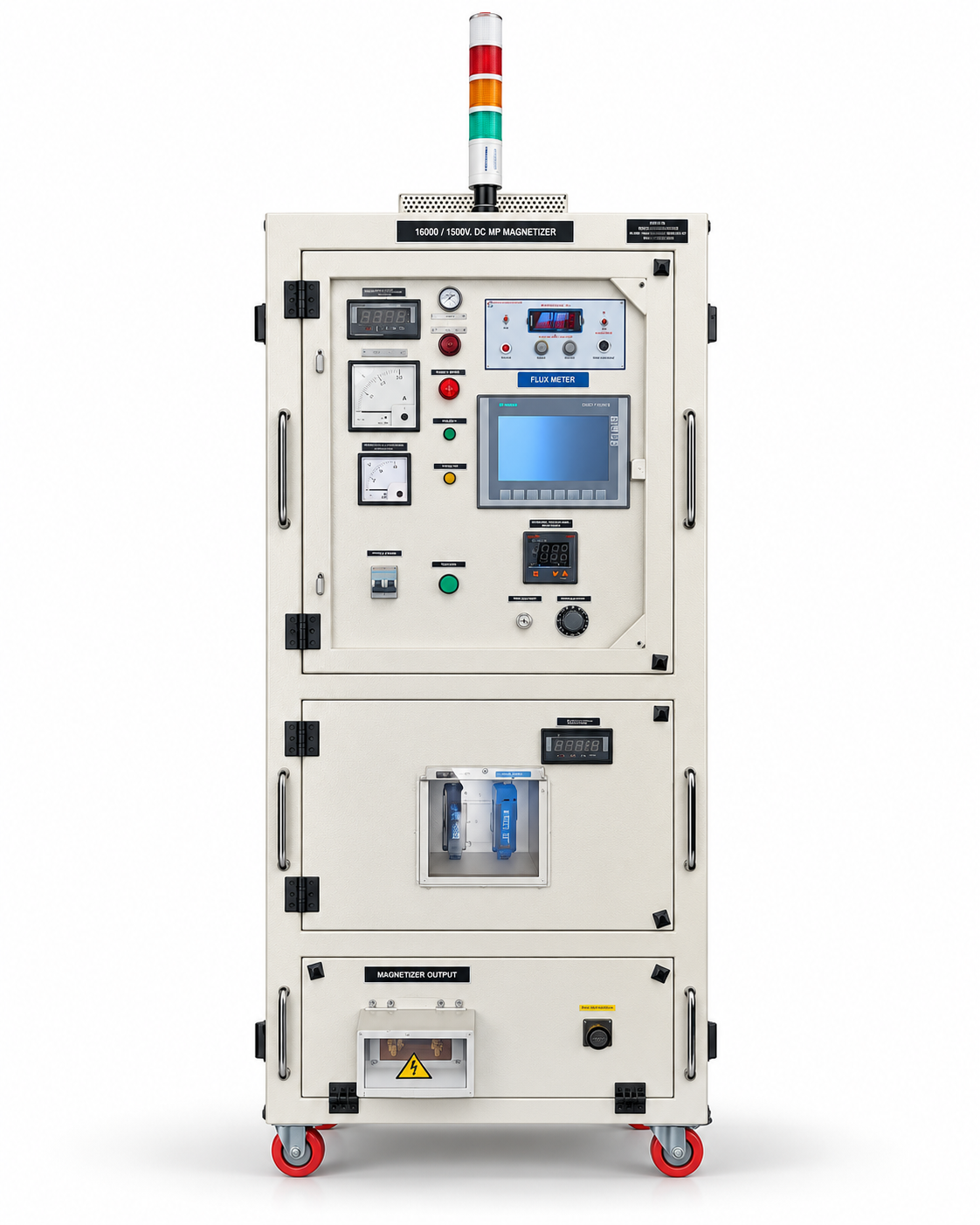
The most common reason a magnet underperforms is not a bad material but an incomplete magnetization. If the field inside the magnet never reaches the level its material needs, the part leaves the machine only partly charged. This article sets out roughly how much field each of the four main permanent magnet materials needs, and how to check that you are getting there.
Key takeaways
- A magnet should be driven to saturation. Below that point, output is lower and varies from part to part.
- A widely used rule of thumb is a magnetizer field of about three times the material’s intrinsic coercivity (Hcj). Some sources quote two to three times.
- Approximate saturation fields: ferrite about 1–1.5 T, NdFeB about 2.5–3.5 T, SmCo about 3.5–5 T and alnico about 0.3–0.5 T.
- The figure that matters is the field inside the magnet, which is affected by fixture design, air gaps, surrounding steel and eddy currents.
- A saturation test on real parts is the most reliable way to set the production voltage.
Why full saturation matters
Magnetization aligns the magnetic domains in the material. When every domain that can align has done so, the magnet is saturated and reaches the remanence its grade allows. A partly magnetized magnet produces less flux, so a motor loses torque, a loudspeaker loses sensitivity and a sensor gives a weaker signal. Worse, the shortfall is rarely uniform, so output varies across a batch in ways that are hard to trace.
The rule of thumb and its limits
Intrinsic coercivity, Hcj, describes how strongly a magnet resists demagnetization. It also gives a useful first estimate of how hard the magnet is to magnetize. The common guideline is to apply a field of about three times Hcj, and in any case comfortably above the point at which the material stops responding.
Treat this as a starting point rather than a specification. For high-coercivity grades, applying the multiplier literally can give very large figures. Many magnet suppliers state a recommended magnetizer field on their datasheets, and a saturation test on the actual part is the final word.
Units at a glance
Magnetizer fields are quoted in teslas, kilo-oersteds or kiloamperes per metre. In air, they convert as follows:
| Value | Approximate equivalents (in air) |
|---|---|
| 1 T | 10 kOe, about 796 kA/m |
| 1 kOe | 0.1 T, about 79.6 kA/m |
| 1,000 kA/m | about 12.6 kOe, about 1.26 T |
Approximate fields by material
| Material | Typical Hcj (approx.) | Approx. field to saturate | Electrically conductive? |
|---|---|---|---|
| Hard ferrite (strontium or barium) | About 2–5 kOe | About 1–1.5 T (10–15 kOe) | No |
| Sintered NdFeB | About 12 kOe to over 30 kOe, depending on grade | About 2.5–3.5 T (25–35 kOe) | Yes |
| Samarium cobalt (SmCo) | Commonly about 15 kOe and above | About 3.5–5 T (35–50 kOe) | Yes |
| Alnico | About 0.5–2 kOe | About 0.3–0.5 T (3–5 kOe) | Yes |
These are approximate, general figures. Always check the magnet supplier’s data for the grade you use.
Ferrite
Ferrite is the easiest of the high-volume materials to magnetize and, being ceramic, it does not suffer from eddy currents. It is widely magnetized after assembly in DC motor housings and loudspeakers, and in batches as loose magnets.
NdFeB
Sintered NdFeB needs a much stronger field. High-coercivity grades used for elevated temperatures, such as SH, UH and EH, sit at the upper end of the range and can need more. NdFeB is electrically conductive, so thick parts and magnets fitted inside steel assemblies need a pulse long enough to penetrate fully.
Samarium cobalt
SmCo is among the most demanding materials to magnetize. Sm₂Co₁₇ grades are generally harder to saturate than SmCo₅. Both need a high-energy system and a fixture built to withstand the resulting forces.
Alnico
Alnico needs comparatively little field, but its low coercivity means it is also easily demagnetized by handling, stray fields or poor magnetic circuit design. For that reason it is usually magnetized in its final assembly. Higher-coercivity grades, such as alnico 8, need more field than the common grades.
From field to machine
A coil’s nominal field figure is not the field inside your magnet. The field actually reaching the material depends on:
- Fixture geometry. A magnetizer coil for loose magnets gives a fairly uniform field, while radial and multi-pole fixtures concentrate it in specific regions.
- Air gaps. Clearance between the winding and the magnet reduces the field at the part.
- Surrounding steel. Rotor cores and housings can help guide flux, or can divert it away from the magnet if the fixture is not designed around them.
- Eddy currents. In conductive magnets and steel, they oppose short pulses and delay penetration of the field.
- Pole pitch. In multi-pole magnetizers, closely spaced poles make it harder to drive full field deep into the magnet.
The required field and these factors together set the energy and voltage the magnetizer needs. Our guide on how to choose a magnetizer covers the sizing steps, and how a capacitor discharge magnetizer works explains the pulse itself.
How to confirm saturation in practice
A saturation test is simple and needs no special theory:
- Take several unmagnetized samples of the real part.
- Magnetize them at increasing charging voltages, one setting per sample.
- Measure each one with a flux meter and Helmholtz coil, or with a gauss meter in a repeatable position.
- Plot the reading against voltage. The curve rises steeply, then flattens.
- Set the production voltage with a sensible margin above the point where the curve flattens.
Magnet manufacturers use the same approach when they magnetize loose magnets before dispatch, and it is equally useful when recharging magnets that have weakened in service.
Need help choosing?
If you are unsure whether your current set-up saturates your parts, or you are planning to magnetize a new material, share the magnet grade, part drawing and output required. The SK Enterprises team can recommend a magnet charging machine and coil or fixture to suit.