SK Enterprises Manufacturer of Industrial Magnetizers & Magnetic Instruments — Maharashtra, India

Magnetizer Fixtures, Coils & Yokes

BLDC Rotor Magnetizer Fixture for Fan, Hub & EV Motors

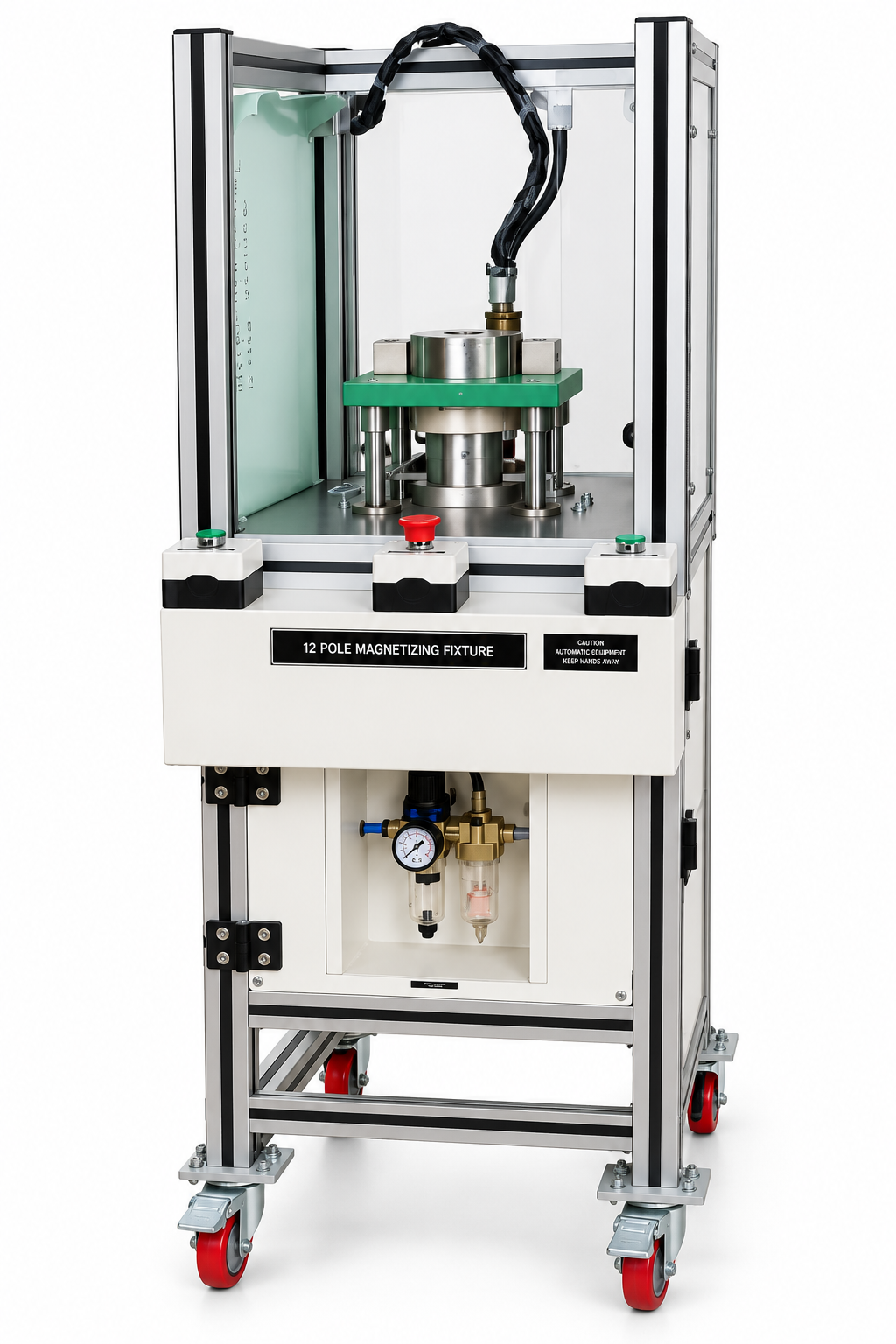
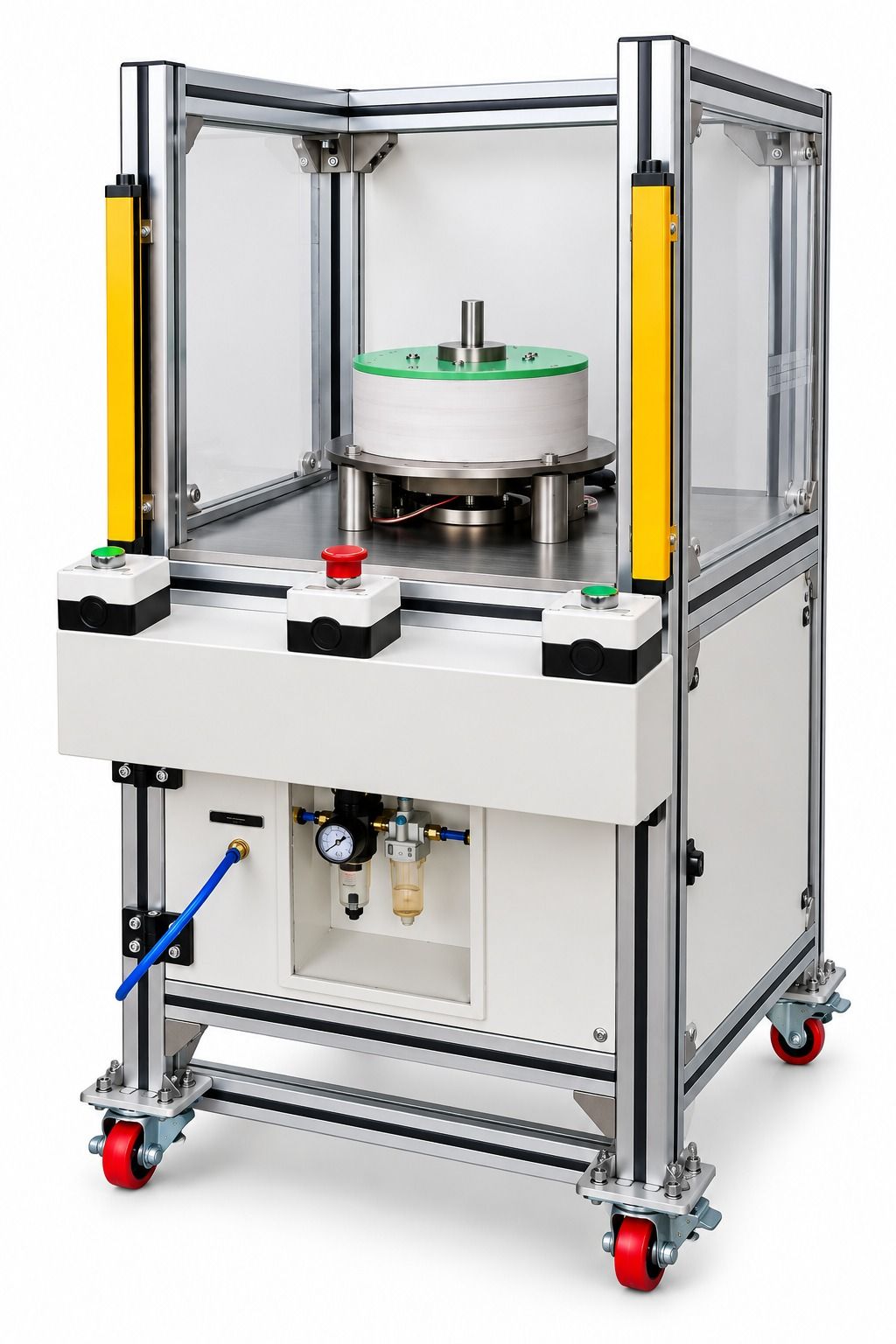
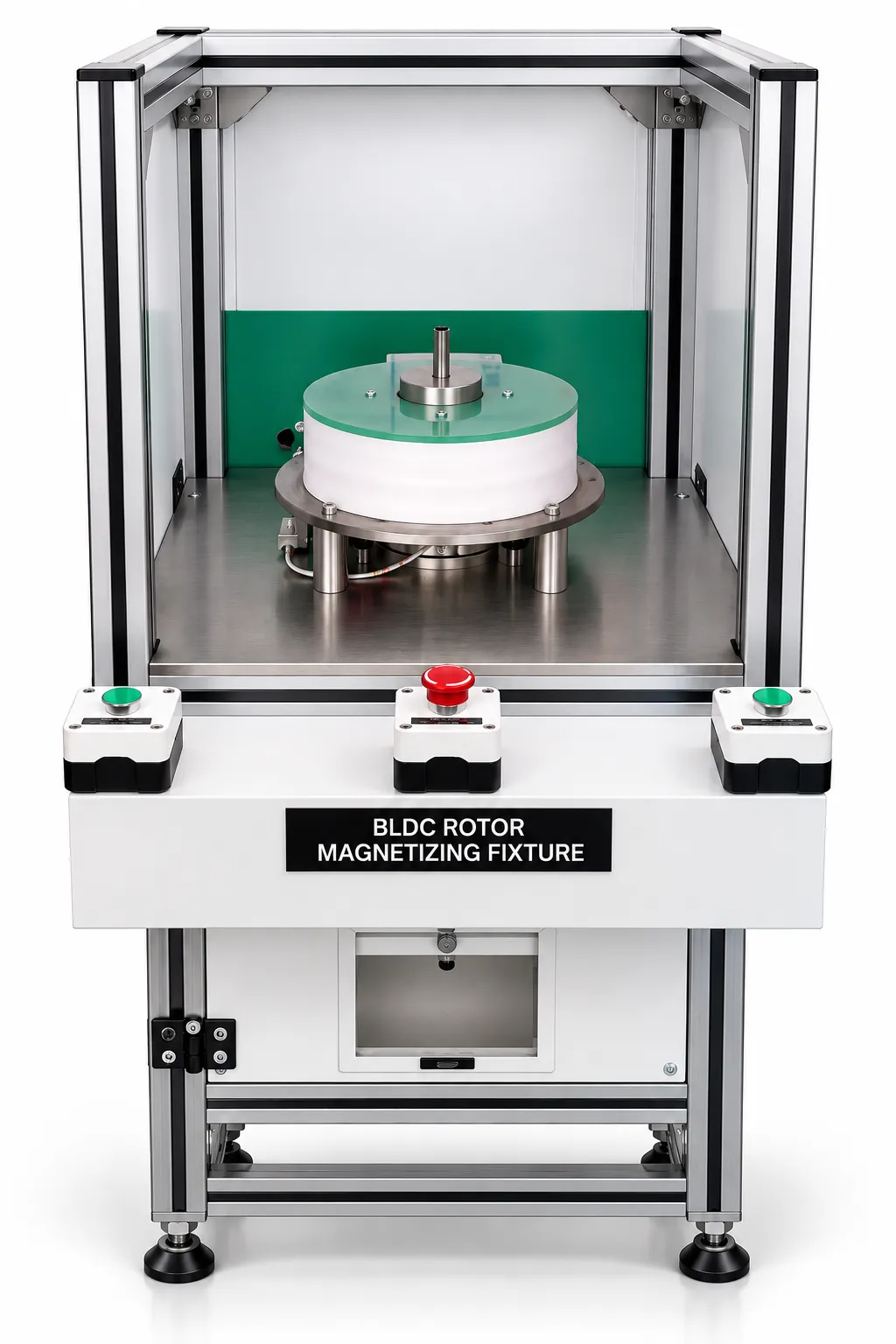
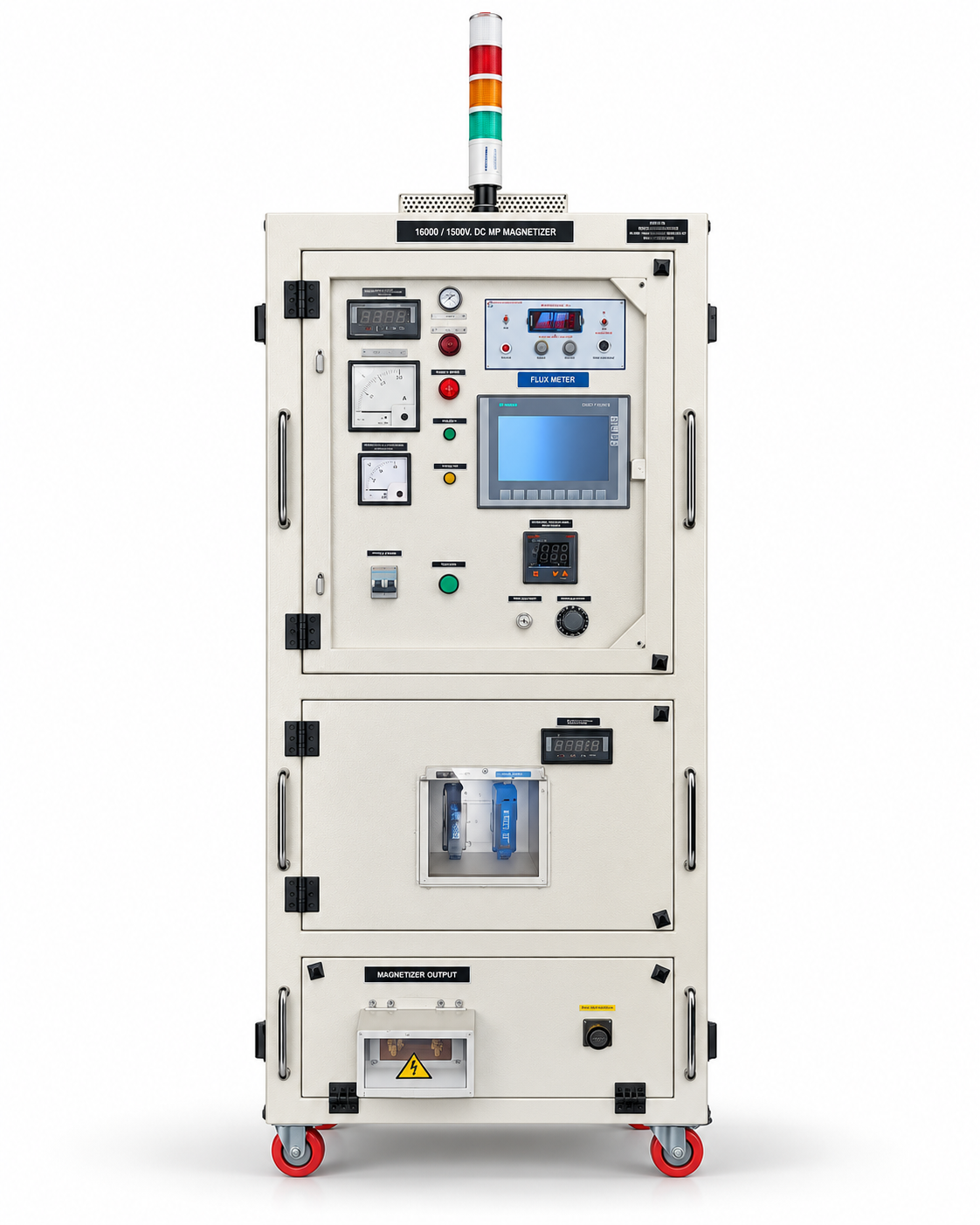
A BLDC rotor magnetizer combines a capacitor discharge magnetizer with a fixture built around one rotor design. The assembled rotor — core, magnets and usually the shaft — is loaded into the fixture, and a single pulse forms the north and south poles together in a radial multi-pole pattern. SK Enterprises manufactures rotor magnetizers in Maharashtra for companies making BLDC ceiling fan, pump, hub motor, e-rickshaw, EV and servo motors who want to magnetize rotors on their own assembly line.

  • Magnetizes inner-rotor and outer-rotor BLDC and PMSM designs
  • Rotor is assembled unmagnetized and magnetized as the final step
  • Fixture pole count and position matched to your magnet layout
  • Straight or skewed poles to suit the motor design
Pole pattern
Radial multi-pole, matched to rotor
System
Capacitor discharge magnetizer driving a part-specific rotor fixture
Rotor configurations
Inner rotor (fixture surrounds the rotor) or outer rotor (fixture fits inside the rotor ring)
  • Direct from manufacturer
  • Built to your part
  • Application support

Product overview

About BLDC Rotor Magnetizer Fixture

How a rotor magnetizer works

A rotor magnetizer is a magnet charging machine for BLDC rotors: a capacitive discharge impulse magnetizer paired with a fixture made for one rotor design. Conductors run along the length of the fixture at every pole boundary, and the current direction alternates from one conductor to the next. When the capacitor bank fires, several kiloamperes flow for a few milliseconds and the field between each pair of neighbouring conductors drives the magnet beneath it north or south.

Because the pole pattern comes from the fixture’s geometry, pole position does not depend on how an operator places pre-magnetized magnets. That is a big reason why magnetization after assembly is standard practice in volume BLDC production — magnets can be glued and sleeved, and the rotor balanced, while everything is still unmagnetized and free of clinging steel particles. The page on rotor magnetizers shows where this step sits on a motor line.

Rotor types and fixture arrangements

Rotor type Typical magnets Fixture arrangement Typical motors
Inner rotor, surface magnets Ferrite or NdFeB arcs, or a one-piece ring, on the outside of the core Rotor slides into the fixture bore Pumps, blowers, servo and appliance motors
Outer rotor, surface magnets Ferrite or NdFeB arcs bonded inside a steel rotor ring Fixture fits inside the rotor BLDC ceiling fans, e-bike and EV hub motors
Interior magnets (IPM) NdFeB or ferrite blocks in lamination slots Field must pass through the steel stack to reach the magnets Compressor and other high-efficiency motors

Surface-magnet rotors are the most straightforward to magnetize after assembly. IPM rotors are more demanding because the field has to reach buried magnets in the right direction, so each design needs a feasibility check before a fixture is built.

Fan, e-mobility and EV motor rotors

BLDC ceiling fan rotors

Most BLDC fans use an outer rotor: ferrite or NdFeB magnets, or a bonded ring, line the inside of a steel rotor shell. An inner fixture fits into the shell and forms every pole in one pulse; on arc-magnet designs, the rotor is located so each pole is centred on its segment. Fan lines run in high volumes, so cycle time and fixture cooling matter as much as field strength. Our guide on how BLDC ceiling fan rotor magnets are magnetized walks through the process step by step.

Hub motor and e-rickshaw rotors

Hub motors for e-bikes and e-scooters are also outer-rotor designs, but larger, with many NdFeB arc magnets bonded inside the hub. Many e-rickshaw and other three-wheeler BLDC motors use similar rotors, whether hub-mounted or driving the axle. Magnetization after bonding avoids fitting dozens of strong magnets by hand. Large diameters and high pole counts need more energy, and very large rotors may be magnetized a group of poles at a time with indexing between pulses.

EV traction and industrial motor rotors

Inner-rotor PMSM rotors for electric vehicles, servo drives and industrial motors may use surface magnets or interior (IPM) magnets. Surface designs are usually magnetized after assembly; IPM designs are assessed individually, as described above.

What to specify

Pole count and alignment

A fixture produces one pole count, and it must match the motor design. On rotors built from separate arc magnets, the fixture locates the rotor from the shaft, a keyway or a pin so that every pole transition falls in the gap between two magnets rather than across one.

Skew

Skewing the poles along the rotor length reduces cogging torque. The skew angle comes from the motor designer and is built into the conductor slots of the fixture.

Magnet grade, pole pitch and energy

Sintered NdFeB needs a far stronger field than ferrite to saturate — roughly 2.5–3.5 T against 1–1.5 T — so the magnet grade largely decides the energy and voltage required. High pole counts on small diameters add difficulty: narrow poles leave less room for conductors, and the field does not reach as deep into the magnet. Our article on multi-pole magnetizers explains this trade-off.

Cycle rate and checks

Output per shift decides fixture cooling — natural air for lower rates, forced air or water for continuous production. Peak-current monitoring confirms that every pulse was delivered, and a surface flux scan or back-EMF test against a reference rotor confirms the result. Together they make an industrial rotor magnetizer a controlled process step rather than just a machine on the line.

Rotor magnetizer machines made in Maharashtra, supplied across India

SK Enterprises builds rotor magnetizers as matched machine-and-fixture systems, alongside the other magnetizer machines in our range.

What decides the price of a rotor magnetizer?

A rotor magnetizer is configured around one or more rotor designs, so there is no catalogue price. The main factors that decide the cost are:

Cost driver How it affects the price
Energy rating Large-diameter rotors, high pole counts and high-grade NdFeB need a bigger capacitor bank than small ferrite fan rotors.
Voltage The machine, cables and fixture insulation must all be rated for the maximum charging voltage.
Fixture design Pole count, skew, inner or outer magnetization, rotor location and quick-change features all add machining and design work. Each extra rotor design normally needs its own fixture.
Cooling and cycle time Continuous fan or pump lines need faster charging and forced-air or water-cooled fixtures.
Controls and monitoring Peak-current monitoring, data logging and an attached flux-scan or back-EMF test station add to the cost.
Automation Pneumatic or automatic loading, part detection and PLC links to the assembly line add hardware and engineering.
Installation On-site commissioning, operator training and spare parts form part of the total project cost.

The useful comparison is cost per correctly magnetized rotor, not the machine price alone. A system that saturates every rotor at your line rate avoids the rejects and rework that an undersized machine or overheating fixture brings.

Send your rotor drawing, magnet material and grade, pole count and required output, and we will propose a configuration with its price. Request a quotation for a rotor magnetizer.

Specifications

BLDC Rotor Magnetizer Fixture specifications

Typical technical specifications
System Capacitor discharge magnetizer driving a part-specific rotor fixture
Magnetization pattern Radial multi-pole; pole count matched to the rotor (always an even number)
Rotor configurations Inner rotor (fixture surrounds the rotor) or outer rotor (fixture fits inside the rotor ring)
Magnet arrangement Surface-mounted arcs or rings; interior (IPM) magnets where the design allows post-assembly magnetization
Magnet materials Sintered and bonded ferrite, sintered and bonded NdFeB; SmCo with suitable energy
Typical field to saturate Approx. 1 – 1.5 T for ferrite and 2.5 – 3.5 T for NdFeB (grade dependent)
Pulse Typically a few milliseconds, with peak currents of several kA to tens of kA
Fixture cooling Natural, forced-air or water cooling, chosen to suit the cycle rate
Common quality checks Peak-current monitoring, surface flux scan or back-EMF test against a reference rotor

Typical values for this product type, for reference. Exact values depend on grade, size and design — confirm with our team before ordering.

Models & supply from SK Enterprises
Rotor sizes supported On request
Pole counts On request
Magnetizer energy ratings On request
Fixture options On request
Monitoring & testing On request
Automation On request
Warranty On request
Lead time On request

Sizes & variants

Common types and variants

Inner-rotor fixtures

The rotor slides into a bore lined with pole conductors. Used for rotors with magnets on the outside of the core, such as pump, blower and servo motors.

Outer-rotor fixtures

The fixture sits inside the rotor ring to magnetize magnets bonded to its inner face — the layout of most BLDC ceiling fans and hub motors.

Skewed-pole fixtures

Conductors are set at an angle along the rotor length to produce skewed poles that reduce cogging torque.

Indexed magnetization for large rotors

Where a rotor is too large to magnetize in one pulse, a fixture can magnetize a group of poles at a time while the rotor is indexed between pulses.

Applications

Applications of BLDC Rotor Magnetizer Fixture

  • BLDC ceiling fans

    Outer-rotor fan motors magnetized after the magnets are bonded into the rotor.

  • Pump and appliance motors

    Inner-rotor BLDC and PMSM rotors for pumps, blowers and household appliances.

  • E-bike and EV hub motors

    Large outer rotors carrying many NdFeB arc magnets, magnetized after bonding.

  • Servo and industrial motors

    Precision rotors where pole position and skew affect smooth running.

  • Ring-magnet rotors

    One-piece bonded NdFeB or ferrite rings on small BLDC rotors, magnetized multi-pole in place.

Features & benefits

BLDC Rotor Magnetizer Fixture features & benefits

Key features

  • Fixture built around your rotor Bore, pole count, magnet span and stack length are taken from your rotor drawing.
  • Repeatable pole alignment The rotor is located from its shaft, a keyway or a pin so pole transitions fall between magnet segments every time.
  • Machine and fixture matched Energy, voltage and fixture design are chosen together so the pulse saturates the magnets without overloading the fixture.
  • Ready for production use Cooling and loading are specified for your output per shift.

Benefits for your business

  • Clean rotor assembly Unmagnetized magnets can be glued, sleeved and balanced without collecting steel particles or snapping onto tooling.
  • Consistent motor performance Every rotor receives the same pulse, which helps keep back-EMF and torque consistent from motor to motor.
  • Safer line handling Strong magnetized rotors appear only at the end of the line, not at every workstation.
  • One machine, several rotors Changing the fixture lets the same magnetizer move from one rotor design to the next.

Industries served

Industries that use BLDC Rotor Magnetizer Fixture

Get the right BLDC Rotor Magnetizer Fixture for your application

Send your part drawing, magnet material and output per shift. Our engineers will recommend the right configuration and send a quotation.

FAQs

BLDC Rotor Magnetizer Fixture — frequently asked questions

Can a rotor be magnetized after the shaft is fitted?

Yes, in most cases the rotor is magnetized as a complete sub-assembly with its shaft. The fixture is designed with clearance for the shaft and uses it, or another datum such as a keyway, to locate the rotor so the poles land in the right position.

Do I need a separate fixture for each rotor?

A fixture is built for one rotor diameter and pole count. Rotors with the same diameter and pole count but different stack lengths can often share a fixture that is long enough for the longest stack. The magnetizer itself can drive many different fixtures.

Can interior permanent magnet (IPM) rotors be magnetized after assembly?

Often, but it is more demanding than with surface magnets. The field has to reach magnets buried in the lamination stack and line up with their orientation, so feasibility depends on the rotor geometry and magnet grade. Some high-coercivity IPM designs use pre-magnetized magnets instead, so each design should be assessed from its drawing.

What is skewed magnetization and when is it used?

In a skewed fixture the poles run at a slight angle along the rotor length instead of straight. Motor designers specify skew to reduce cogging torque and smooth out running; the angle comes from the motor design and is built into the fixture.

How do we check that each rotor is fully magnetized?

Common methods are peak-current monitoring on every pulse, scanning the field around the rotor surface with a Hall probe to check pole strength and position, and back-EMF testing in a motor or test stator. Comparing results with a known good reference rotor makes deviations easy to spot.

Can hub motor or e-rickshaw motor magnets be re-magnetized?

Sometimes, but each motor has to be assessed first. Recharging restores magnetization, not damaged material, so it is only worthwhile if the magnets are not cracked, chipped, corroded or coming loose from the rotor. The rotor must be separated from the stator, and it needs a fixture that matches its diameter, pole count and original pole positions — large rotors with high-grade NdFeB magnets also need a lot of energy. Where magnets have been badly overheated, part of the loss may be permanent and replacing the magnets is the reliable fix.

What is the price of a rotor magnetizer in India?

There is no fixed price, because each rotor magnetizer is built around a rotor design. Rotor size, magnet material and grade, pole count, skew, fixture cooling and cycle rate, monitoring, automation and installation all affect the cost. Send your rotor drawing and expected volumes and we will quote for the right configuration.

Related products

All products

Knowledge centre

Guides about BLDC Rotor Magnetizer Fixture

Get a quote

Request details for BLDC Rotor Magnetizer Fixture

Fill in what you know — our team will follow up with a recommended configuration, price and delivery time.

We’ll call or WhatsApp you on this number.
PDF, Word, Excel or image — max 5 MB.

Prefer to talk?

Call or WhatsApp us with your requirement — we’ll help you choose the right magnetizer and fixture.

WhatsApp Us