SK Enterprises Manufacturer of Industrial Magnetizers & Magnetic Instruments — Maharashtra, India

Application

Multi-pole Magnetizer

A multi-pole magnetizer puts several alternating north and south poles on a single ring, disc or rotor in one pulse. The pattern is set entirely by the fixture, so pole count, pole width and accuracy have to be designed in from the start.

Where multi-pole magnetizers are used

  • BLDC, PMSM and servo motor rotors, including outer-rotor fan and hub motors.
  • Encoder and speed-sensor rings, including rubber-bonded ferrite encoder tracks.
  • Two-wheeler magneto flywheels.
  • Magnetic couplings and small synchronous motors in pumps and meters.

How a multi-pole fixture works

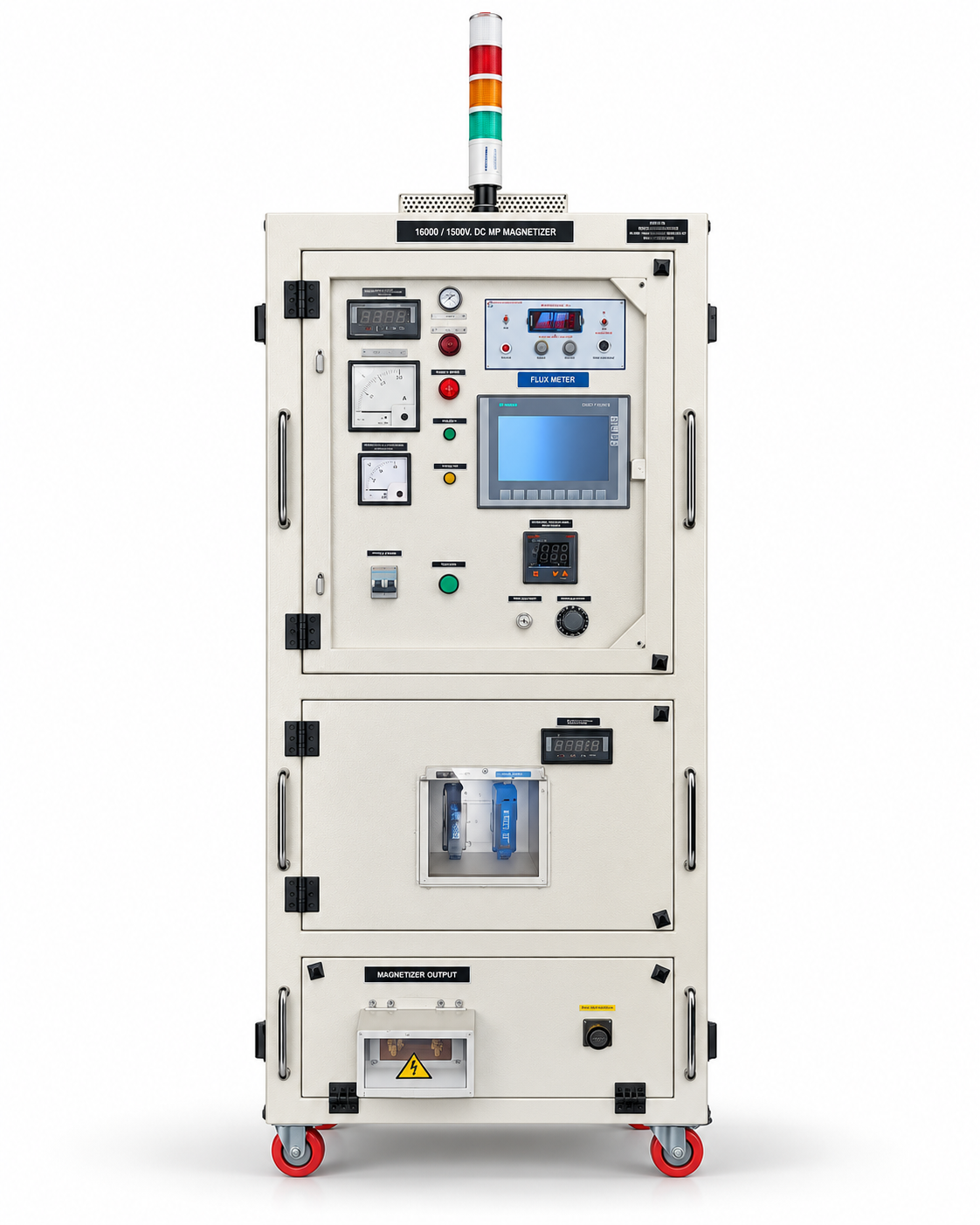
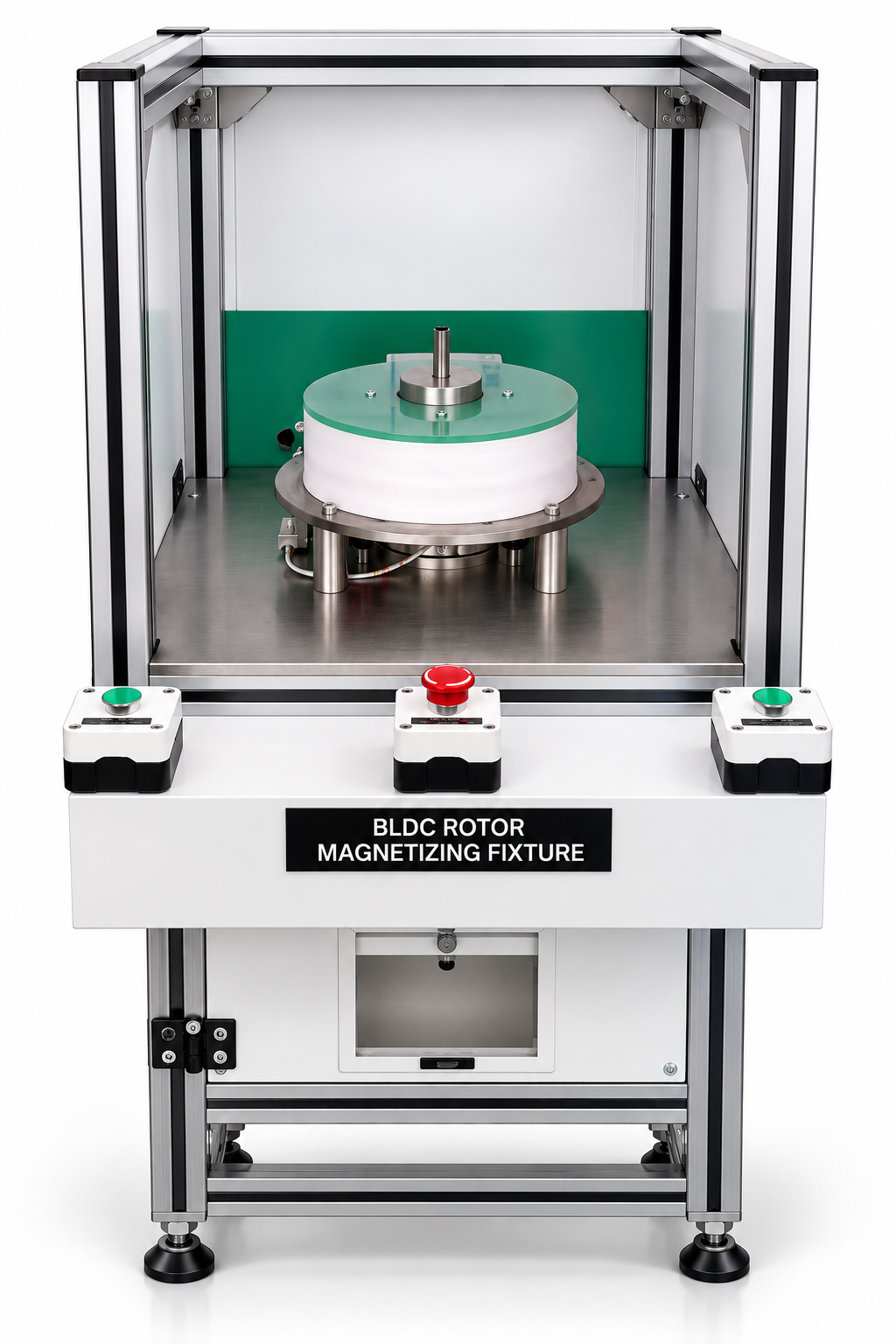
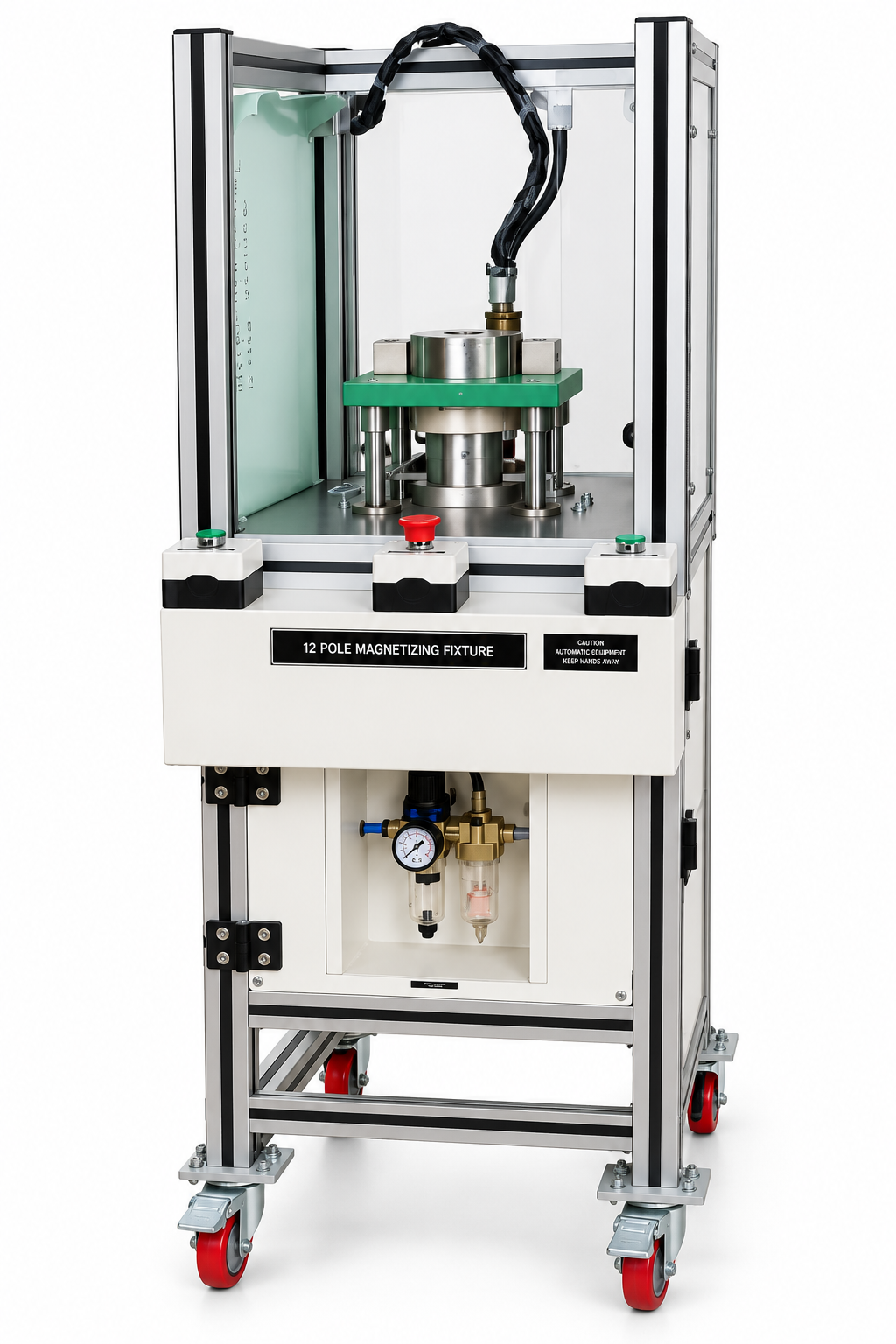
A multi-pole fixture carries conductors arranged around the part so that current flows in opposite directions in neighbouring conductors. When a capacitive discharge impulse magnetizer fires a pulse of a few milliseconds through it, the region between each pair of conductors becomes a north or south pole. Depending on the part, the fixture can act on the outer diameter, the inner diameter or one face.

Because the pattern is fixed by the fixture’s construction, each multi-pole magnetizer fixture is made for a specific part and pole layout.

Key design parameters

Pole count and pitch

The number of poles and the part diameter together set the pole pitch. Fine pitches need conductors close to the magnet surface, and the field does not reach as deeply into the magnet, so thickness and pitch have to be considered together.

Pole accuracy

Pole positions depend on how precisely the conductors are placed and how the part is located in the fixture. In encoders and motors, small errors show up as signal error, cogging or noise.

Skew

Some rotors need poles magnetized at an angle along their length, often to reduce cogging torque. The skew is built into the fixture conductors.

Field and heating

The fixture must still reach saturation, roughly 1–1.5 T for ferrite and 2.5–3.5 T for sintered NdFeB, while carrying very high current in fine conductors. Cooling decides how often it can fire.

Read multi-pole magnetizers explained for more on fixture design, or see how these fixtures are used in a rotor magnetizer.

Enquire about multi-pole magnetizers

SK Enterprises designs and manufactures multi-pole fixtures and magnetizers in Maharashtra, India. Send your part drawing, magnet material, pole count and any skew or accuracy requirements. Request a quotation for your fixture.

Relevant products

Products for multi-pole magnetizer

FAQs

Frequently asked questions

Is there a limit to the number of poles?

In practice, yes. As poles get narrower, the fixture conductors must be smaller and closer together, the field reaches less deeply into the magnet and the fixture runs hotter. Thick magnets with fine pole pitches are the hardest to magnetize fully.

Do I need isotropic magnets for a multi-pole pattern?

Isotropic magnets, such as many bonded NdFeB and bonded ferrite rings, accept any pole pattern. Anisotropic magnets can be multi-pole magnetized too, but they must have been oriented to match that pattern when they were made.

How is the pole pattern checked?

Magnetic viewing film gives a quick visual check. A Hall probe scan around the part measures each pole's position and peak field.

Can you make a fixture for our existing magnetizer?

Often, if the magnetizer's voltage, energy and current suit the fixture design. Share the magnetizer details along with your part drawing.

Talk to our engineers about your requirement

Share what you need to magnetize — part, magnet material, pole pattern and output. We will recommend a machine and send a quotation.

WhatsApp Us